‘Walks with Gord’ comprises six anecdotal observations, starting August 20th, 2020.
Gord, an enthusiastic walker with an adventuresome spirit, enjoys the outdoors and loves to explore the area where we live, 1 Ripley Avenue in Toronto, and he invited me to tag along.
Taking note of the wonder of it all was solely my idea.
Note: the role of Gord will be played by Sheila on this walk; Gord isn’t looking well.
Alert: note the date – summer has officially 3 weeks to go but we know better.
Walking with Sheila will cry out for comparisons with Gord’s ambulations which could have me walking the plank. I’ll try to watch my step.
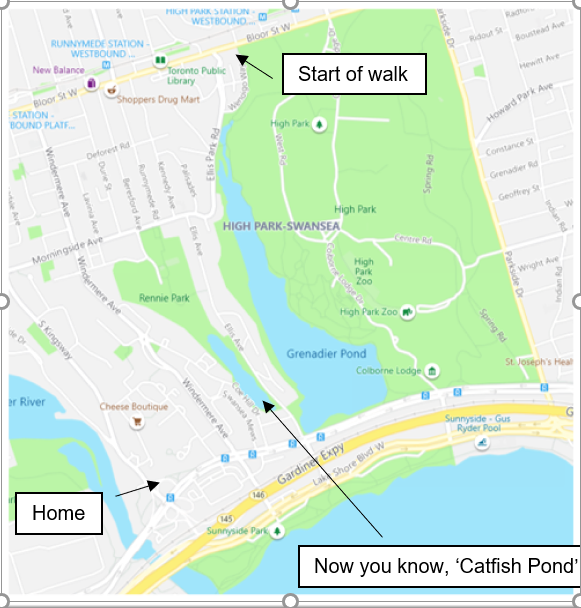
My plan is to introduce Sheila to the wonders of the Williard Walk which she’s heard so much about and only men know so much about. This starts with a walk north on Ripley Avenue, Gord and I usually head directly to the South Kingsway.
Ripley Avenue is going through a minor transformation with all parking spots getting a clean bill of health thanks to repaving and bright yellow park-between-the-lines. This route must have more cars per parking spot than any other street in Toronto. And, of course, the Cheese Boutique attracts a clientele that hasn’t walked to a store since Henry Ford appeared on the scene.
Back to the South Kingsway now a street that houses the small and the mighty but doesn’t discriminate when it comes to parking. Melding into the morning traffic and leaving the evening rush hour to your once-was-a-lawn driveway can’t be the highlight of anyone’s day.
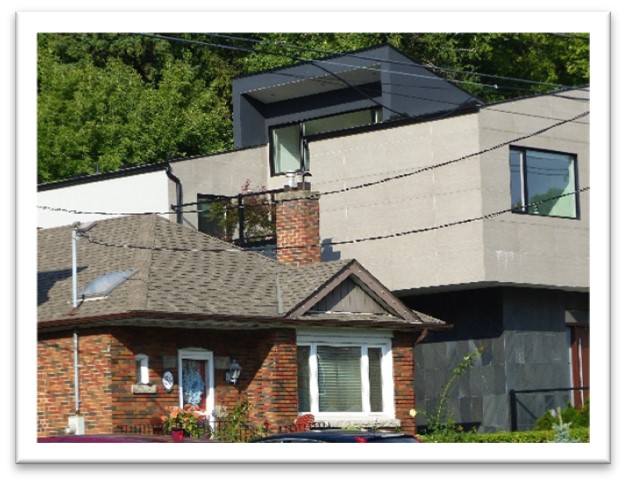
Speaking of the small, this picture shows an-about-to-be-torn-down up against a neighbourly transformation. (The building to the right will soon lose not only the light-facing windows when the replacement McMansion surfaces and, I’m guessing, but also around $250,000 off any future listing.)
I can clearly envision the conversation between the supposedly little old lady owner of the teardown and the shaking with high commission fever real estate agent.
“Well, it’s time to move; Arthur, that’s my late husband, and I bought this place just after the war.”
“I understand, hard to pull yourself away. Any questions?”
“Well, we want to get our money back, we scrimped and saved to find the down payment and then pay off the mortgage.”
“… do you recall … hmm … what you paid … roughly?”
“No roughly about it, $6,500!”
“A mighty sum at that time, I’m sure. Let’s see, accounting for inflation (agent counts through all her fingers and toes and back again) I can assure you that you’ll get your money,( sotto voce) less an egregious commission, back.”
“What about staging, I hear that a lot.”
“No need, just take what you want and leave the rest.”
“That’s going to be a lot of work, clearing out things. Who will move them?”
“The bulldozer.”
The walk up to Bloor is a gentle incline but you’re glad when you see the Esso station on the corner. And then Sheila points out the pet stores; there are three establishments in the area catering to the pet-o-philes (say that clearly). It’s obviously a dog-eats-a-lot-of-dog-food world.
This makes it official
Sheila also shows me the restaurant Ma Maison on the north side of Bloor. They had (maybe still do) a restaurant opposite Bruno’s plaza (not sure of the mall’s correct name) on Dundas street just east of Royal York. At the time, it was one of the few establishments that had a legitimate French touch so it will be a welcome addition to the area.
Bienvenue!
By now you’re starting to appreciate the difference between an all-talk-and-no-looking walk with Gord and a pause-and-see-everything stretch with Sheila.
As an aside, everyone’s seen that cartoon that highlights the difference between men and women shopping for a sweater? The half dozen red dots on the floorplan indicate the man’s path to and from the parking lot to the store where he buys a sweater versus the several thousand dots that trace the woman’s journey to every store in the mall and the return to the car without the sweater but with lots of other things. Well, this is the walk equivalent. Sheila goes, or at least notes, where no man has gone before.
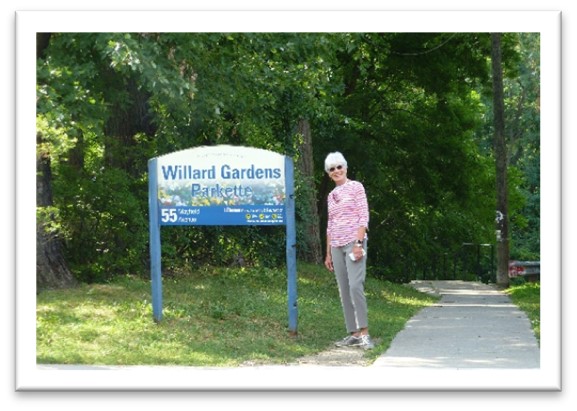
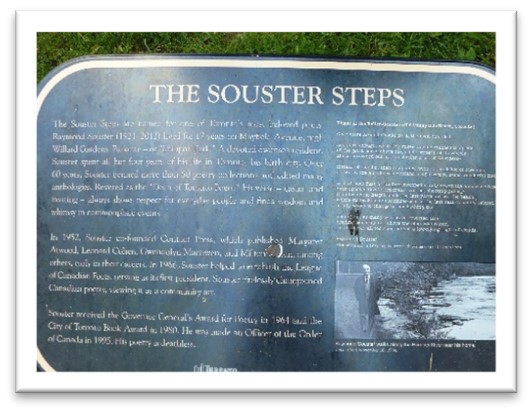
We start our descent down the Williard Walk and something new catches our eye, (Gord and I have a lot of important things to talk about that takes all our attention: ‘How are you feeling? How’s the dog? Pretty warm for this time of day, eh?” so it’s to be expected that we would miss the plaque honouring Raymond Holmes Souster, a recognized poet from the area and a supporter of the arts.
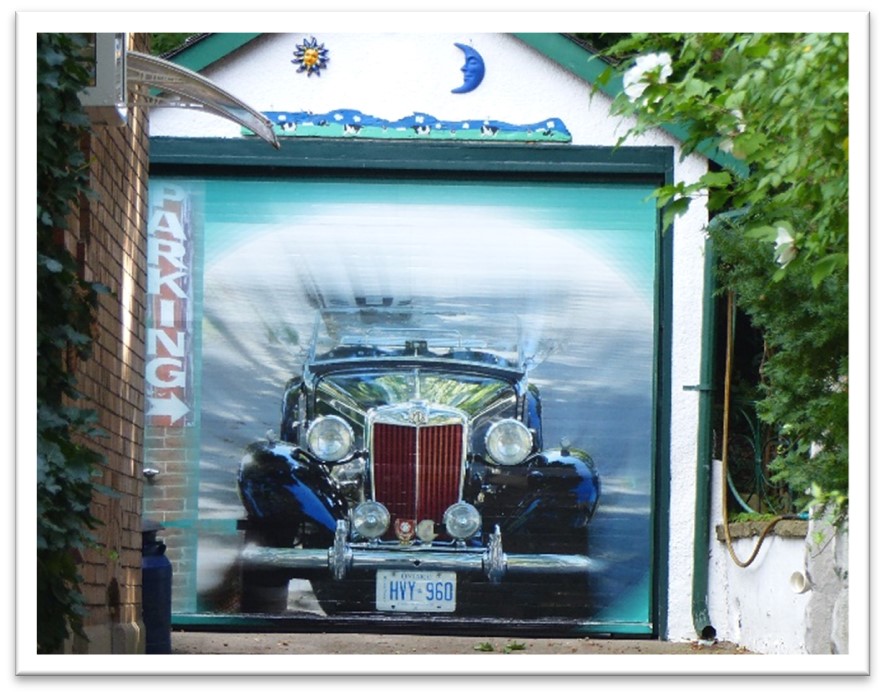
Towards the end of the walk, Sheila announces, “This is great, but,” checking details that escaped Gord’s and my eyes like the car painted on the garage door, “I’ve been here before.”
A very realistic MG and I’m guessing a TD, maybe a 53?
I can’t hide my disappointment, I was the one showing her the walk. “But how?” I unbelievably mutter.
“Well, I remember walking on the South Kingsway and saw people seemingly disappear so I followed them.”
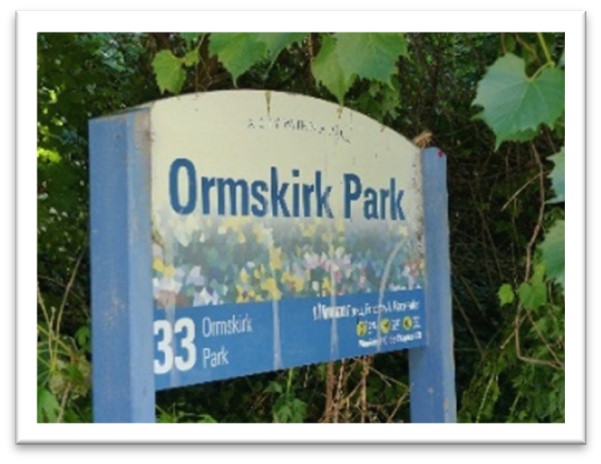
And with that Sheila not only points out the hidden Ormskirk Park that Gord didn’t know about but also the steps leading up to Windermere and parts to be known. “I’ll take you there sometime.”
No Gord (not feeling well) and no Sheila (shopping) this time, just me but I feel it’s worth a telling.
I had to go to the Runnymede library today (It’s back open now that COVID-19 has settled down.) to drop off a book and pick up one I’d reserved lo these many months. I’m impressed, the library kept track of it and let me know when I could venture into their sanctum to retrieve it. As an aside, the library is almost empty. A COVID-19 forced change from my recent memory when it was awash with, among others, the great unwashed who looked to it to satisfy their free newspaper reading needs and welcome warmth or comforting cooling depending on the season.
I was struggling with the choice of walking to the library or taking my bike. The bike, an e-bike, is the obvious choice but you can’t carry anything on it. It’s a male gender version which forbids baskets woven, wicker or otherwise. It would be a balancing act at best that seniors don’t take to well or too well. So Sheila solved my dilemma, “I’ll drop you off on my way to wherever.”
I confess to changing my male determining decision making. The thought of being driven up the hill and then walking down to home was pure pleasure. I highly recommend it. You cover off your guilt of ‘not getting out and doing some physical activity’ and make it home in one piece with breathing to spare.
The library is at the top, the north west corner, of High Park. High Park, for those not in the know, is close to being Toronto’s version of New York’s Central Park. If it were, it would be separating the Toronto towers with greenery but it’s further west than downtown. Its purpose, though, is the same as Central Park’s – to provide humanity with an oasis of nature almost completely shielded from the look and noise of civilization.
While cars can use it, only going one way to the south, the 20 kilometer speed limit keeps them to a safe crawl which leaves the roads and pathways open to cyclists, walkers, walkers with dogs and wanderers like me on this marvelous morning. And what a morning for mid September – a forecast high of 23, sunny and dry.
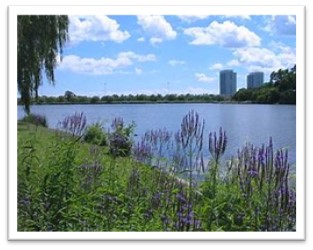
Grenadier Pond, looking south, Lake Ontario lurks beyond.
When you have time on your side you get to see what you’d miss from a moving car or speeding bike. For example, you get to read all those signs that tell you what you didn’t study in school. My first lecture tells me that not so long ago, Grenadier Pond, the body of water that keeps High Park attracting water fowl and ice skaters was once an open body of water connected to Lake Ontario. Now it’s land locked but has a man made connection with the Humber River to the west to handle any runoff.
The signs continue to educate you along the way on the fish and fowl that abound. I didn’t know that there were two types of Canada Geese (Branta canadensis – aren’t you glad your parents forced you to take Latin?) and the type Canada loves is the one that migrates so that we can share the treasures the bird leaves when it leaves for places as far away as Europe.
Speaking of fishes (yes, this plural refers to species; fish would mean the same darn fish, singular and plural.) and one of the species is the northern pike, a sporting angler’s favourite.
I take a moment to test a bench that hopefully hadn’t lost a ‘fresh paint’ sign and page through the book I picked up at the library. This is indeed a pleasurable moment; only the bench’s hard design forces me to move prematurely.
The rest of the walk home takes me around the southern perimeter of Grenadier Pond and west along the Queensway to South Kingsway and off at the first right to Ripley Avenue.
When you walk these routes that border runways for racing cars you not only feel the traffic rushing by you but also the comfort of probably not getting run over, an obvious bonus over biking which makes you wonder if cycling, even with its own lanes, even with all this effort made nowadays to win over the cyclist, is the way to go.
So I’ve added three kilometers to our walks. When Gord gets to read this I’m sure he’ll say with mock indignation, “Well, you really haven’t walked High Park,” which is what I hope he’ll say. Then we can get together again and he’ll show me the way.
When a ‘Doctor’ tells you to get some blood work done, (‘We need to do it to check for atherosclerosis,’ oh, of course, why didn’t you say so?) you should immediately start formulating a plan to not get blood work done. (More on the whys later). Admit it, you suspect your ‘Doctor’ hasn’t a clue what’s wrong with you, if anything. It’s your annual checkup and he’s fishing; probably suspects you’re a hypochondriac. At least you don’t display any obvious near death symptoms. You got to his office on your own steam. You read and signed his liability agreement absolving him of all blame should you contract some virulent virus during your examination. So you push back. And herewith all you need to know to build up an effective defense. You may wish to take notes.
Look away
First thing, confirm that he/she’s a physician and not a Doctor of Religious Studies or a doctoral student in metallurgy.
Take note, too, of the only expensively framed piece of yellowing paper on his/her wall; make sure the largest letters, the ones in bold and in Old English Text don’t start with the English words: ‘School of …’ You’re looking for: ‘University of …’ or ‘Yale’ or ‘Harvard’. ‘School of Yale’ fixes locks.
Be suspicious also if the city in question is misspelled, diploma mills always get ‘Albuquerque’ wrong.
Always look for a diploma that’s in Latin; this doesn’t ensure your physician of choice is any good but a good litigation lawyer can sue for more.
And start to wonder when waiting room reading material is current.
If the above doesn’t get you out of this blood sport, try to talk your physician out of getting the work done. Suggested questions:
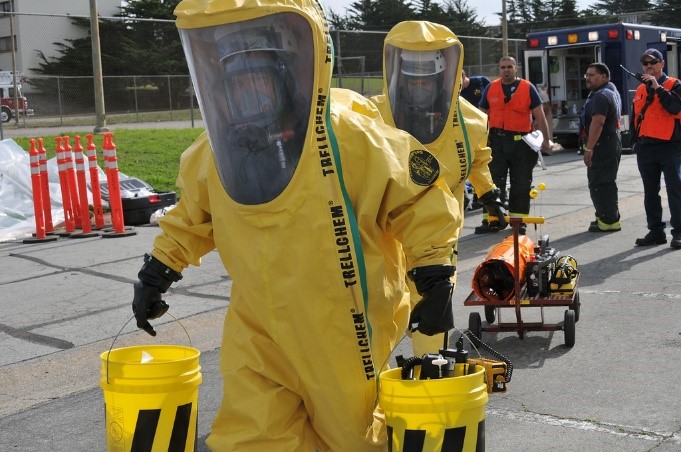
I feel fine, I always look like this. Why are you putting on a hazmat suit?
Which classes did you skip that require you to get a second opinion?
Can you trust the lab doing the analysis? Ask for the name of the lab. The lab’s name shouldn’t be in Latin. When you get home, Google, ‘Joe’s lab and gravel pit.’
Humour him, (‘I need to do this to test for hyperhidrosis,’ two can play this game.) ‘What do you call the individual who came last in their graduation class in medical school?’ Answer:Doctor.
Needles and me? Faintsville.
Once he dances around these questions and points out that specialists like himself charge by the minute, grudgingly accept the requisition form and get ready for the next stage.
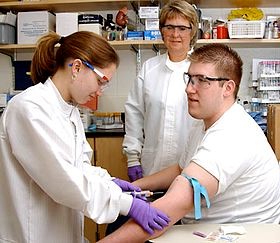
You’ve had blood work done before, what’s the big deal? Half an hour out of your retired life; some small pain going in and a bit more when you remember to rip off the bandage later and lots of nervous small talk, ‘Nice day, eh? I didn’t realize that there’s a school for puncturologists.’, and then along came COVID-19.
And this is the real reason you want to avoid blood work today. As promised, here’s the (more later).
The cozy waiting room that seated a dozen or so in the past and provided a semblance of comfort for your half hour wait is now a maze for a few people standing that measure 6 feet when they fall down. So you wait outside the lab, even on the street, until the shuffling gets you here.
Since you didn’t book a time, you get to wait an indeterminate time outside the lab or on the street because the slight young female in charge, the one with the clipboard, has trouble accurately determining the wait time.
You arrive at 9:30 a.m., the lab opened at 7:00 a.m. “You’ll be about an hour,” she soothes. You count bodies lingering about and your eyebrow arches, “An hour my eye.”
But I sense a wondering pause from you dear reader, yes, I did go on line to make an appointment and the earliest available day, not necessarily convenient time, was a week away.
‘I want you to get this blood work done immediately, we don’t have a lot of time.’
‘What, you’re going on holidays? It can’t be anything serious, I drove here and backed in.’
So you wait impatiently and take the time to look around. We’re in a medical building so the required pharmacy occupies most of the street floor. A poster for compression socks greets your wandering eye. Why not? Everybody waiting around is north of 70. Can’t see trampoline manufacturers fighting for shelf space.
But the poster appeals to your looks, or lack of them, because it tells you that these compression socks are sexy and to prove it the model who is sporting them all the way up to her exposed thigh must be all of sixteen years old (Why do they choose models that have no relation to reality? Why would she need anything? – ed) and drop dead gorgeous. And she’s smiling. (Note to self: order a dozen.) How can someone smile when half their body is in compression? I look around the waiting area; the lot of us has seen better times. Are they at the tipping point in their beauty cycle where compression socks are going to get them back with George Clooney?
“Notice anything different, cutie pie?”
Male person of the relationship in a lose-lose situation, “Hmm, well, you look … er … comfortable.”
“I’m wearing compression socks.”
“Ah that’s it, you handle pain well.” (Dictionary flies across the room.)
Then another poster, sans model this time, reminds you that ‘Diabetic socks here.’ I didn’t know. My limited knowledge of the condition always had sugar in the conversation. Hard for me to equate the two, “Those are one set of sweet socks you’re wearing.” Tough sell, I figure, limited George Clooney appeal.
This pharmacy knows its audience: no Viagra ads, no special on 50 kilogram weights to get your abs in shape; no stats on the wall showing you how fast you should run 10 kilometers. Even the pharmacist is no threat, leaning on his walker dispensing wisdom.
Back to reality. Well, the fun had to begin and begin it did with an individual who had had enough of waiting since he had waited long enough; over three hours. He followed the script and started yelling at the slight young thing. Unfortunately she hadn’t had advanced training in how to calm down an incensed individual (I always wanted to say, were I in a similar situation, “I have a gun.” But I digress.)
So I stepped in, I thought I could take him in 2 out of 3 falls if things got out of hand. Fortunately he didn’t turn from the slight young thing and kick me in the shins but hostilities did calm down. There was no applause.
I, too, cooled my jets for 3 hours and was finally ushered into the inner sanctum, the former waiting room described above. Alas, nothing changed from the outside, you wait here, too. It looks promising, however, you can see the end of the line.
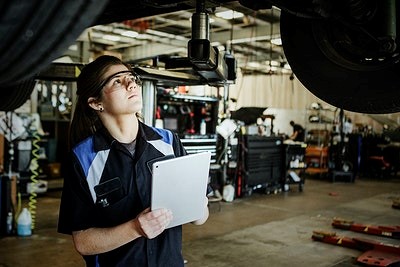
You can also see that the staff are not the reason for any holdup. They’re bustling but there’s paper work. Most patients are handy handling a smart phone so a lot of the data is already digitized. But then it hits you, the form you’re gripping was digitally produced, e-mailed to me which I then printed because that’s what it said to do but why isn’t that data already in the lab’s computer? Why don’t the technicians have an ipad with all that information? Like the guys at my car dealership?
That doesn’t look good
“Your oil change is done, Mr. Legon, but we see from your chart that you could use some blood work. Won’t take a minute, hop up on the hoist.”
You daren’t ask for fear of being sent to the end of the line. Ah, memories of misbehaving in public school.
“You have a question? You want to know why the Encyclopedia Britannica doesn’t agree with me? Why don’t you think about it in the cloak room? Way you go. And come back when you’ve settled yourself.”
I know, the technically advanced among you have the answer; the computers don’t talk to one another. The doctor is government; the lab is private enterprise. But still.
Now comes the blood letting. There’s nothing to it, as you’ve doubtless experienced. Your blood cells are as impatient as you are, they want to get out of there. Three tubes later, properly bar coded, and part of your life starts its new journey.
And that’s why you should try to avoid doing blood work. You’ve painfully endured roughly 4 hours of your day standing, sitting, listening to sane people argue – all to do what should be a simple procedure that you didn’t ask for in the first place and, let’s face it, you really don’t want to know the results.
Admit it, when you buy a jigsaw1The name ‘jigsaw’ came to be associated with the puzzle around 1880 when fretsaws became the tool of choice for cutting the shapes. Since fretsaws are distinct from jigsaws, the name appears to be a misnomer. The ‘fret’, however, does have a certain amount of verisimilitude. puzzle you wonder,
“Is this the one puzzle of the gazillion jig saw puzzles produced that’s missing a piece?”
The wondering doesn’t stop there and you surmise how it could happen. The disgruntled employee, fired for studying for his PhD on company time, on his last day on the job, opens the box, takes out a piece, reseals the contents and makes sure shipping sends it your way. And not an edge piece, no, you’d discover that right away; the piece or pieces missing are the key to getting Mona Lisa to smile.
The wondering continues as you spread the pieces on that piece of felt you paid $49.95 for (more on that later) and as you struggle you conclude, “There’s gotta be a piece missing!”
Of course, there’s no piece missing. It’s you that’s missing the patience and confidence to solve this bloody thing.
I was never a fan but peer pressure at the cottage forced me to show some interest in jig saw puzzles.
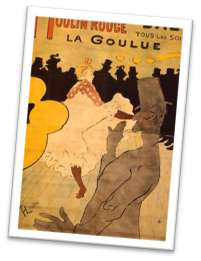
I mean, this is a trivial task. To start, you have to turn over all the pieces, I could handle that in public school. Then you have to set out all the edge pieces. That I mastered doing in high school. Then you have to look for something in the accompanying picture that you could quickly build; how ‘bout working on the letters in ‘Moulin Rouge’? That problem solving focus I acquired in third year engineering.
Why do we do it, then? Why do we put our back out from repeatedly standing and bending; why do we punish our eyes from staring at a teeny, tiny piece of cardboard; why do we spend hours at a time at this and then realize this unfinished masterwork has to be moved somehow to free up the table for dinner?
I know, when you get a piece to fit without hammering it in with your fist, you get a dopamine hit. Talk about simple pleasures.
Now that the picture is taking some shape, you tackle the monochromatic wall that commands half the picture. Had you paid the slightest attention to the puzzle when you bought it, you would have noticed that vast stretch of ochre without a hint of relief and quickly gone for the puzzle of the Magna Carta in Latin.
But you can do the wall. Now that you’ve lowered yourself to this level of cerebral challenge, you decide you’re going to show the world that you’re one smart dude and can analyze the problem scientifically, professionally, maturely to guarantee a rewarding solution.
No, you say to yourself, I will not test every single piece of amber-bay-beige by trying to jam it into the welcoming piece then picking at it to get it out then turning it 90 degrees and trying again to jam it into the welcoming piece then picking out the now frayed piece turning 90 degrees …
No, you will expertly study the scene looking for minor variations in the bland backdrop. You decide to look to a magnifying glass to help unravel the mystery. Then you bring your favourite reading lamp to the game; the one with the high octane bulb you favour when you want to read the fine print on your lottery win. All this to give this exercise the intensity a person of your learned and competitive nature demands. You will bring this beast to ground.
When you can’t take that two Tylenol pain that’s hammering the back of your head any longer, you move on. You work on the mole on the subject’s visage instead; you’ve seen that piece somewhere.
Now for that two square foot piece of felt you paid more for than a square mile of the finest cashmere. The entrepreneur that bemoaned the fact that you had to move the unfinished puzzle to eat at the dining room table figured out that he or she could make a buck by supplying a piece of felt that you just roll up for another day.
To get the most for the felt, however, he/she had to include:
Instructions (my favourite)
A piece of plastic that you inflate to create a roll that you will then use to wrap the piece of felt around. That piece of felt is currently holding the 7 pieces you managed to connect in your first hour plus the remaining 1,000 – 7 scattered pieces of the puzzle.
Two elastics to hold the piece of felt you wrapped around the inflated sausage of plastic so your life’s work doesn’t unroll.
And finally, a piece of rejected material that becomes a sack to hold the piece of felt rolled around the tubular balloon you’ve lost a lung over trying to inflate and securely fastened with two elastic bands.
Cost of materials:
$2.07
Skills required:
However long it took one to learn to write instructions that require grade one level reading skills.
Now, solving a jig saw puzzle isn’t a singular event; everyone gets to have a hand in. Family members and visiting friends who questioned your maturity when you bought it, surprisingly take a passing interest when they can pick up a piece, seemingly at random, and plop it accurately into the place where it should go that you haven’t been able to sort out for the better part of a morning. But they can’t just walk away as they walk away,
“How long have you been working on this?” comes the disdain.
You want to remove the piece they just put in and triumphantly replace it yourself. You think ahead, “Better hide a couple of pieces in case they come along when I’m not here and finish the darn thing.”
And so it goes, but you pay for your pastime. There’s probably a post doctoral thesis that confirms the more expensive the puzzle the more time it takes to solve it. And the more, from doubtless a future study, satisfaction you get from piecing it all together.
“You know that puzzle of the Magna Carta in Latin?” you rhetorically ask of no one in particular.
“No.”
“I solved it.”
For me there’s always a final let down; you finished it, now what? You stare at the finished impression of this artist’s masterpiece and decide, even though it’s the only Henri de Toulouse-Lautrec you’ve got, not to get it framed.
You’re now at the crossroads: you’re never going to do it again; hard to make it a gift and tearing it apart would only reawaken your three year old tantrum days. So you gently dismantle it, preserving some recognizable chunks for future admiration, and put everything high up on the shelf that harbours your revered 33 and 1/3 Gene Autry LPs and move on to the more important things in life now that you’ve cleared the table, so to speak.
The name ‘jigsaw’ came to be associated with the puzzle around 1880 when fretsaws became the tool of choice for cutting the shapes. Since fretsaws are distinct from jigsaws, the name appears to be a misnomer. The ‘fret’, however, does have a certain amount of verisimilitude.