A day in late April has warmed up enough to overcome COVID-19 and the lockdown to draw me outdoors.
“I’m going for a walk,“ I announce to my wife hoping, not too seriously, that she’ll try to talk me out of it.
“Good, maybe you’ll meet up with someone,” came the helpful farewell. I head for the elevator lost in thought.
A ghost from the past joins my reverie, “Roger.”
I turn to see James, a casual acquaintance who has a suite a few floors below us.
“Whatcha up to?”
“Decided to go for a walk.”
“May I join you?”
And so, with a friend in mind, we head out into the great unknown. I’m younger than James so I mentally add 30 minutes to this venture and subtract a kilometre.
“Love a brisk walk,” announces James to no one in particular.
I have to smile, James’ idea of a brisk walk is more like an animated shuffle. But he keeps up the enthusiasm if not the speed. We decide to head for the Humber river which means crossing the busy South Kingsway which means being alert and remembering how to turn an animated shuffle into a brisk walk.
In my youth I’d have to be on top of things to take on this no-traffic-light crossing, the traffic never seems to abate, so with James I look both ways several times, add an extra kick to my step and then get him in gear. James has perfected the semblance of running which encompasses a flailing of arms supported by shaky limbs that hope to move without scraping a toe or dragging a heal. We make it but I’m sure that the driver who slowed down had to be cursing or was himself of a certain age and admired our adventuresome spirit.
We pause to get our oxygen levels back up and head to the Humber which attracts kayakers at this stage of the waterway. You immediately take this activity off your bucket list. You know you could never get in or out of those things. James, being of like mind, without prodding, unconsciously shakes his head.
“Can you come and get me?”
“Where are you?”
“In the middle of Lake Ontario.”
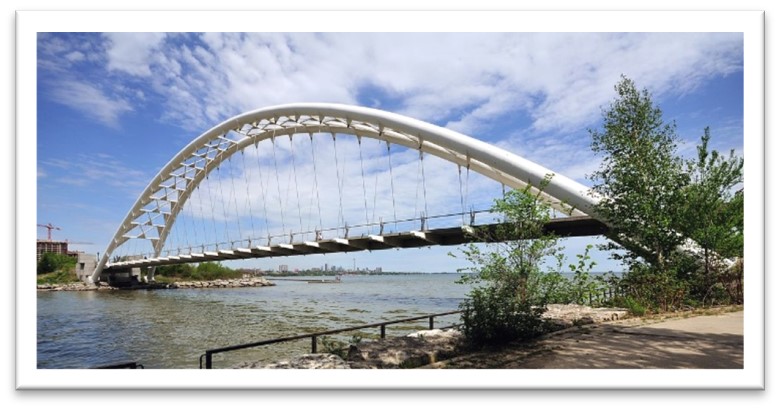
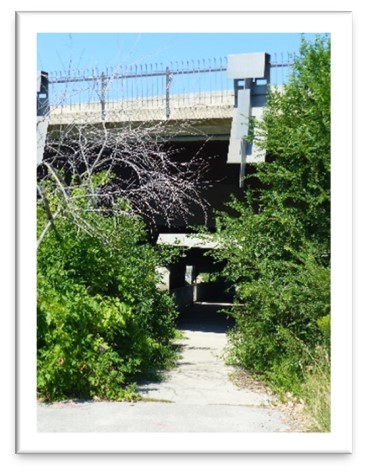
We next take a goat path which leads us under the Gardiner and Lakeshore overpasses which opens onto the mouth of the Humber where it’s crowned by the archway bridge. Here we greet Lake Ontario and a myriad of people: walkers, bikers, dog walkers, fast bikers all in assorted dress from shorts to winter attire and generally not wearing a mask or trying to stay six feet apart. James and I have our masks in hand but have taken them off to avoid the annoyance of fogging up our glasses. But we do try to stay the necessary distance away from the crowding company.
We note, for the first time in our memories, lake levels are down such that sandbars are exposed to let you walk to the breakwaters.
James is quite opinionated. Something that doesn’t quite sit well with him will get a 2 minute rant.
“You know what I can’t stand,” expounds James, not waiting for an answer, “bikers.”
I wait, James doesn’t need encouragement. “They’re racing, they pass on the right, they don’t pay for a licence, they own the road.”
James doesn’t want to admit that he can only turn his head 10 degrees either way so he couldn’t see a biker coming if he wanted to. Now this is on a combination walk/bike path; I decide not to get his heart pumping beyond the legal limit by asking him what he thought of bikers on the road.
“Another thing,” Oh, oh, I surmise, he’s on a tear, “pollution.”
“Thought we had that in hand, if not under control, no?”
“Not what you’re thinking,” corrected James, “noise,” slamming a balled up fist into an open palm to emphasize the seriousness of the matter, “noise pollution, those bikers (this time he was after the motorized version) and hot rodders pollute the ears with their rackets and it can be stopped.” I await the answer.
“You know when you have to take your car in to test the exhaust?” I nod, he doesn’t want me to say anything, “well there’s probably a gadget that could test for noise at the same time.”
I know James wants my approval but I counter. “That could take 5 years, new cars don’t get tested for 5 years. That would be 5 years of noise according to my calculations.”
James lowers his head as if to get all the brain cells to puddle to the bottom of his skull to muster a critical mass for an appropriate response but I help him out. “Of course, we could pass a law so shops couldn’t sell those things, they’re add-ons that attach to or replace the exhaust.”
James brightens, then shakes his head, “Ah they’d find a way to buy them across the border and smuggle them across, don’t think it would work but a nice thought, thanks.”
“How ‘bout noise police?” I semi-jokingly throw on the table. James gives his brain cells another workout. ”How would that work?”
“Like a breathalyser,” I hurriedly come up with, “stick it up the exhaust and see if the reading is greater than 93.”
“ Why 93?”
“I read it somewhere, that’s when the pain starts.” You can see James likes the idea. You can see that James will take up this idea, hunt down a gadget and test cars stopped at a red light. You can see James getting a swift kick for his troubles.
We are the slowest enjoying the afternoon. Even other walkers clip by us which confounds the brain. We remember when we ran everywhere as kids with nary a puff. What happened? And why do we feel we can still do it? So we get clever and stop to read about the Lake Trail. Reading a sign still counts as walking cause we’re not sitting down. The Lake Trail covers the province starting, or ending, just east of Cornwall with Sault Saint Marie the other terminus. This gets our interest but not commitment as you’d have to be super keen to take any part of this on. Still, it warms you to the wonders of Ontario.
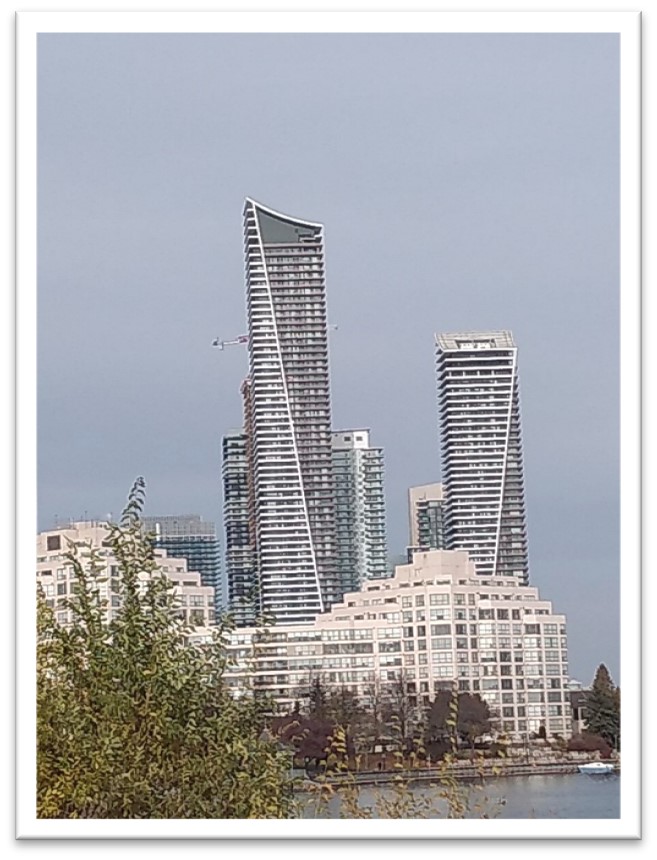
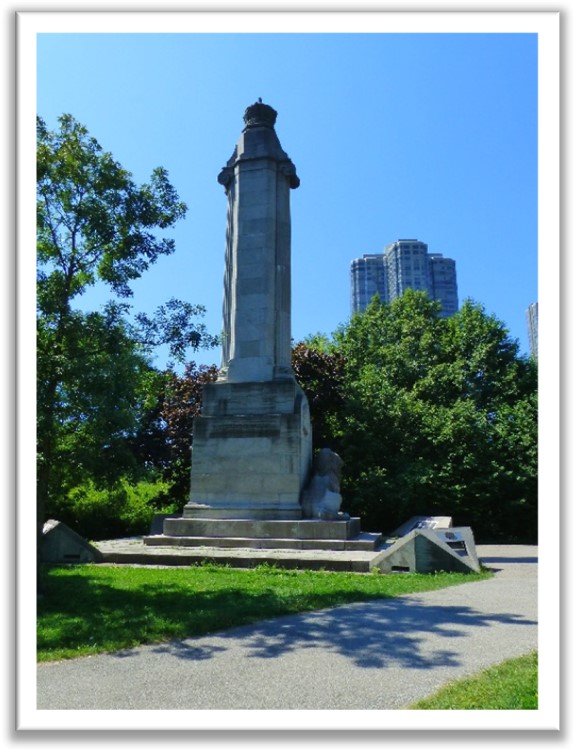
James and I head west to a monument saluting the Palace Pier of days gone by. My sister says she danced there and just about everyone else of a certain age has a story related to this monument to fun. That palace pier, of course, is long gone but its name lives on with an attractive condo tower and its twin, Palace Place.
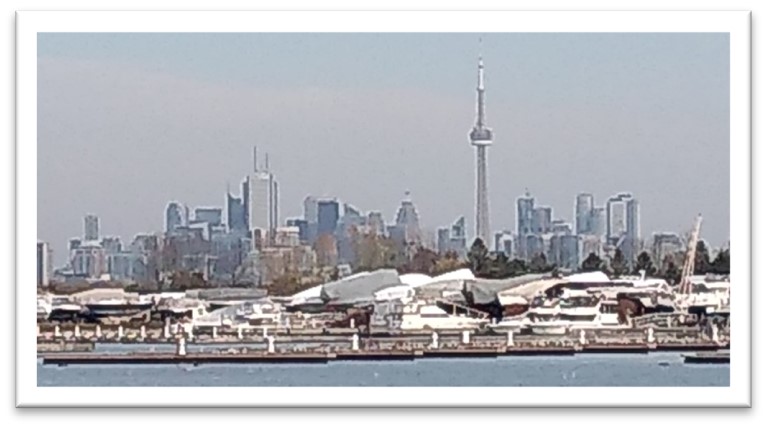
We sit, so we’ve come half way. This part of the path isn’t finished but what is done is very attractive; we drink in the distant skyline of towers. Toronto has a welcoming waterfront.
We decide to not take our chances and take Windermere Avenue home where traffic lights almost guarantee your safety. The walking lights at the Lakeshore are separate: one for east bound traffic and the other for westbound. But they both don’t come on at the same time so you have to move it to cross both lanes of the Lakeshore on a change of lights. We cross the eastbound lane but decide 9 seconds doesn’t give us enough time to fly the westbound lane which is just as well as it gives James a welcome breather and lots of time before the next change of lights to have an opinion on the Mirabella, a condo going up on the Lakeshore.
“An architectural monstrosity,” exclaims James, “I’m glad I didn’t buy into the condo that will soon be blocked from a view of the lake. Can you imagine?”
This revs up James’ engine so we easily make the next light change. We now are on the home stretch but I’m concerned, there’s a subtle grade to our condo and will we need another excuse to make it?
“Ah the rare kingfisher,” pronounces James stopping to wave at some distant speck.
I don’t see the kingfisher, I don’t even look but I can see that James is catching his breath. James is too self conscious to ask for a hand up the hill so we slow down the animated shuffle.
“Home again, thanks for the walk James, I think we covered 3 to 4 kilometres. What’s next on your agenda this afternoon?”
“A nap,” came the unapologetic replay.
And we part.
“Welcome home, how was your walk?” came the warm welcome. “Meet up with anyone?”
“You can’t go back and change the beginning , but you can start where you are and change the ending.”
C. S. Lewis
July 1, 1867, Canada’s first birthday, Clapson Corners. A time for celebration but not for John McGregor and family. John had co-signed a loan for his friend and farming neighbour, Ben Gleason, and Ben had defaulted on the debt so John had to honour his commitment and that meant giving up his farm.
John packed up his family and moved to the neighbouring town of Goodwood and managed to secure a position with the local mill but it was difficult to make ends meet. More importantly, John was no longer a farmer which is what he was good at and longed to do. Soon after, John McGregor took his own life.
July 1, 1952, Canada’s 95th birthday, Sandy Beach. Young Brent Carson celebrated Canada’s birthday playing games, eating hot dogs and revelling in a period in his life that he would always fondly remember.
Life couldn’t get better; summer at the cottage. Never ending days enjoying the freedom of cottage life. Brent had no concept of time, a calendar never guided his days. He was only aware of the end of summer when his folks announced, ‘It’s time to pack up and return to the city.”
Sandy Beach was situated on Lake Jordon, a large body of water that didn’t encourage fishing or boating because it was seldom calm but did draw you into sunning yourself on the sand all afternoon and swimming in its clear, warm waters. You had to wait until the end of June before the waters warmed up but then you had all summer to luxuriate in the near perfect conditions. The beach faced west so it enjoyed the prevailing winds and glorious sunsets.
Cottage life at this time was pretty simple: no electricity, no indoor plumbing, no telephones, no grass cutting, none of the city’s obligations. But no matter.
Sandy Beach had a small downtown, if you could call it that: a drugstore, a summer only goods store, a post office and a sinful greasy spoon with tantalizing pin ball machines. Oh my.
You didn’t have to go all the way downtown though to get the essentials such as milk and bread. A 10 minute walk to Mrs. Jenkins convenience store got you through the week until you went into town to shop. At that time, coal oil for the stove top was the big necessity which forced Mrs. Jenkins, herself, with an audible grunt, outside to the tank around the back. It cost all of twenty five cents to fill the glass bulb which you turned upside down to let gravity feed its contents to the burners.
And the ice man visited regularly to cool down your icebox. You had a square piece of cardboard that had the figures: 25, 50, 75 and 100 on the sides which you put in your window, stuffed between the screen and sides of the frame turned to indicate how many pounds of ice you needed. What a joke, nothing would freeze. It sort of kept things cool. If ice cream was on the shopping list you knew you were having it with that evening’s dinner.
There were twin towns just under an hour away if you needed serious stuff like building materials or clothes or to do the laundry and get booze.
But it wasn’t easy to get a beer then. Prohibition still had a presence. One town, if you can believe it, was dry and the other was wet. Everybody knew why you drove to town #2. And the booze store couldn’t promote itself. If you didn’t know where it was, the locals understood why you were driving slowly and gawking out the window and they kindly put you out of your misery by giving you hand directions.
Funny. But all these things didn’t matter; it was cottage life. It couldn’t get better.
In addition to lazing on the beach, days were filled with playing tennis at a basic tennis court or trying the 9 hole golf course.
At that time, waterfront cottages rimmed the lake and everybody knew everybody. It was typical to put your name on a sign on the nearest tree to your property facing the road. Nobody locked their doors and each cottage had some sort of knocker on its door, typically in the form of woodpecker that you pulled a string to announce your presence. Or there was a wooden box, pen and pencil inside, to say you’d dropped by. Fabulous gimcracks
On one side of Brent’s cottage were the Mace’s then the Williams who had a pump that produced drinking water, which they generously shared as everyone didn’t have an underground stream ideally placed.
On the other side were Brent’s grandparents then the Cargills then the Worthingtons and so on down the line.
Grandma’s cottage was the gathering spot for her clan and their relatives, or as she called it, ‘The Breed’. Grandma’s brother had property at the end of the road so visits were common and conversations settled comfortably into good times gone by.
It’s into this lazy, peaceful scene that murder entered. Ken Cargill, next door neighbour, was found bludgeoned to death.
Chapter two
July 1st, 2020, Canada’s 153rd birthday, the city and Rupert found himself working the holiday. Even the chief was in, things weren’t going well on this holiday weekend in the city, unrest that showed picketers marching through the downtown protesting frozen wages in the midst of a recession with the threat of violence. The mayor didn’t want to leave anything to chance so all hands were on deck.
“Tillinghast”, came the bellow from the chief’s office.
“Chief,” answered Rupert as he entered the sanctum sanctorum. Rupert wondered where the chief got his taste in decorating. Granted his office didn’t give him much to work with; a box roughly 20 feet square with a single window facing north that seldom caught the sun and even more rarely got cleaned. Everything had a pallor that reminded Rupert of the dimly lit catacombs when he vacationed that week in Paris and took in the sites. The walls he had painted in shades of, to Rupert, bilious green with a throw rug of clashing colours trying hard to hide some of the well worn parts on the floor. Pictures of the chief smiling with lesser know personalities dotted the walls and a commendation for ‘good work’ from the force centred over his desk. The pièce de résistance was a brown cracked leather sofa, the only place to sit, that swallowed up its inhabitants so that the chief was always looking down on you. Rupert always stood.
“Have a seat,” ordered the chief officiously nodding towards the sofa.
“I’m good,” came the reply forcing the chief to just giving him the evil eye knowing that he’d never get Rupert to agree to playing his game.
“You’re off to Sandy Beach.”
“I know not of which you speak, is this some kind of penance?”
“No, it’s a summer vacation spot couple of hours north of here on Lake Jordon.”
“Before I thank you for rewarding my stellar service with a well deserved vacation, what about the picketers?”
“No vacation and this is more important, besides you’re a detective, picketers respond better to the reasoning of billy clubs which you don’t possess nor would know how to use.”
“And what, may I ask, calls us to Sandy Beach?”
“Murder, a miss Sarah Smith.”
“Ah, and the locals … “
“Just constabulary, no detectives. Here’s the file. You’re helping out a friend of mine.”
And with that, Rupert returned to his desk and studied the dossier.
Chapter three
The two hour drive was pleasant as all the traffic had jammed the roads the night before. Rupert enjoyed the drive, nice to get away from the city. Driving alone relaxed him. Rupert’s car didn’t have satellite radio, he didn’t drive enough to warrant it or drive any distance to appreciate having the same station wherever you were but it did have a scanning feature. Once a signal weakened, the radio went to the next stronger signal. As Rupert distanced himself from the city the music moved from rock to country; discussions went from serious with politicians or leaders of industry to light banter with the locals; even the ads seemed less immediate and dramatic.
While it lasts, Ritchie Feed and Seed meets all your manure needs at 10% off.
Once he got there, It wasn’t easy to find the Smith’s. Cottage directions rarely put names to streets and numbers to properties. Rather, owners loved to come up with cute names such as, “Bide a-way”, “Sunset Paradise” and Rupert’s favourite, “The last resort.”
Some folks kindly added their names to the signage and the Smith’s, fortunately, just posted their name. After questioning a series of locals, Rupert found the Smith’s cottage, yellow tape was still cordoning off the area and a police car stood guard. Rupert rolled down the window, introduced himself and a parking space appeared.
“Sean Nixon,” greeted Rupert, “You must be Rupert Tillinghast, thanks for coming, “I head the local force out of Bentington, Sandy Beach doesn’t have a police force.
Sean seemed like an affable fellow. All of six and a half feet and helplessly gangly. Rupert put him in his mid 50s. Light red lines on his nose, broken capillaries Rupert surmised suggesting a lifetime of not refusing a tipple. How demanding could it be working the cottage circuit?
“Thanks, I might be here for a couple of days, any suggestions on where tostay?”
“It’s the long weekend so there won’t be much here, I’ll call the office and we’ll get you something in town.”
“Thanks, when did the murder take place?”
“Yesterday, the body’s in the morgue at the hospital which doubles as a police facility.”
“And forensics?”
“We handled that, probably not with the experience you people have but I have it at the office. We don’t have murders in cottage country.”
“OK, lets visit the scene of the crime.”
Sarah Smith, born in 1983 was the younger of Trent and Gladys Smith’s two daughters. An accomplished writer of children’s stories Sarah unfortunately inherited cystic fibrosis and was confined to a wheel chair. This didn’t affect her writing but she was basically cottage bound during the summer.
Sarah met her demise with a knife through the heart. No witnesses, everybody was doing something else and no suspects; Sarah was just a great gal enjoying her time with family at the cottage.
Blood stains had darkened the wood floor; they won’t be easy to remove, thought Rupert. Rupert always enjoyed crime series on television and the movies which showed blood forever in a shade of rosy redness to make sure viewers knew that someone had done some bleeding. And while we’re on about what the entertainment world gets wrong, how ‘bout binoculars? You’d think today the viewing public would know that binoculars give you a singular view of one circle not that look that mimics the outline of binoculars. I guess whoever is using the binoculars could decide, at the last second, to switch to a telescope and confuse the viewer but I doubt it.
“Did you do a blood splatter analysis?” asked Rupert.
“Yes, as best we could, but we don’t have the results yet.”
The chief showed Rupert a series of pictures including one of the knife.
“Looks like an ordinary kitchen knife, anything missing?
“We’re not sure, we’re guessing the killer took the knife with him. Cottage kitchen cutlery can be a mish mash of various sets.”
Rupert nodded. “And she was wheelchair bound. Wait” Rupert paused, “this Sarah Smith. Is she the writer of children’s books?”
“I believe so.”
“What a loss, I loved her writing. Gave a book to my niece. She wrote for children but she spoke to adults, too. Had a good sense of humour.”
So, who was here?”
“I have a list, most of the Smith clan was here for the weekend.”
“I’ll need a list of the neighbours who were up for the weekend too, several cottages on each side. What’s the estimated time of death?”
“The call came in around 4 o’clock in afternoon. A neighbour was dropping off something, knocked, and when nobody answered, came in and saw the body. We got here within the hour.”
“So anybody could walk in?”
“Yes, that’s normal cottage life.”
“What do you know about the deceased apart from her being a writer?”
“Very little, certainly the family is in shock, no known enemies. They can’t explain it. Not a robbery. We really have nothing to go on. Oh, now that I think of it, I had forgotten one thing.”
Rupert turned slowly to the chief.
“There was another murder at Sandy Beach, in the ‘50s I believe. I wasn’t here at the time. Never resolved as I recall. I can get you the details.”
“Thanks, that would help.”
Rupert went back to his car and studied his notes. Anybody could have killed her and it was so easy. No break and enter, the victim in a wheelchair and so casual; strangers could freely visit other cottagers and nobody would suspect a thing.
“Chief, I think that’s enough for today here, can we get settled in town and I’d like to get the details on that other murder.”
“Good, follow me. And I got a call that the best hotel in town is expecting you.”
“What makes it the best?”
“Sounds better than the worst; It’s the only hotel in town.”
Chapter four
The star hotel was aptly named; it was a one star hotel. But what could you expect, thought Rupert, if it wasn’t for the men’s pub downstairs it probably wouldn’t survive. Sean left Rupert with the list of the Smiths that were staying at the cottage:
Trent and his wife who would be in their 80s. Their son Fred and his wife and Fred’s children Selina and Sarah, the victim. He’d interview them tomorrow along with the neighbour who found the body.
In the meantime, Rupert took in the town of Bentington named after a seaman who saw the potential in this natural harbour off Lake Jordon. All this and more was well displayed on historical site signs. Bentington had a population of around 13,000 and never moved too far from that number. At one time there was an active granary, still standing, and a rail line to the big city that delivered goods from ships docked from travels through Lake Jordon and connecting waterways. Now it was a growing retirement community because of the good hospital.
Rupert sought out a diner and risked the local fish dish which turned out to be quite good. He complimented the chef/owner but turned down the proffered recipe. Rupert always took the opportunity to learn as much as he could when at a site.
“You’ve been here a while?” Rupert asked of the chef.
“Herb Anderson,” offering a hand to shake, “No, my wife Alice and I moved here about a dozen years ago. Had it with the big city, had a pension and cooked in the army so I looked around and this town has been good for me. And you?”
Rupert shook his hand, “Rupert Tillinghast, here to look into the murder at Sandy Beach.”
“I heard about that. Unbelievable. Alice and I have gone there to swim on weekends; sleepy little place. Hard to accept that going on. Any news?”
“It’s early. That fish was good.”
“Thanks, hope to see you around.”
Rupert headed back to the police station and met up with Sean.
“Here’s the blood splatter analysis.”
Sarah’s body had taken most, if not all, of the blood splatter suggesting she was knifed from the back. Rupert surmised that the killer knew Sarah, came in, greeted her to her back. Since Sarah would have known who it was, she wouldn’t have needed to turn around, carrying on with what she was doing. In effect, Sarah’s body acted as a shield. No clothes to clean.
Forensics didn’t add anything that couldn’t be assumed. All the footprints and fingerprints were of the family and friends. You’d be hard pressed to conclude that someone outside the immediate family and known neighbours was involved.
“I’d like to do some interviews, when are you planning to head to Sandy Beach?”
“First thing in the morning. Please join me, I’ll handle the introductions.”
And with that, Sean and Rupert said goodnight.
Next morning, Sean picked Rupert up at the hotel and together they made the short drive to the vacation spot in the police car.
“This is Helen Henderson, she found the body.”
Helen couldn’t hide her nervousness and lingering shock. Middle age, Rupert guessed in her 40s and not prepared for any of this.
“Mrs. Henderson, this is Rupert Tillinghast of the metro detective squad from the city, here to help us out.”
Helen had trouble looking up but forced a nod.
“I know this has been quite a shock,” intoned Rupert, trying to put on his best relaxing manner, ”would you please go over the moments before you found the body.”
“I’m a guest of Judy Carson’s, we’re best friends from the city, and she’d asked me to drop off some baking that she had done that morning. Nobody answered the door when I knocked, it was a screen door, so I just walked in, planning to leave it on the table and then I saw Sarah, I didn’t know her, she was sprawled on the floor. All that blood. I almost dropped the pie.”
“Where was Judy?” Rupert queried.
“Down by the water, everyone was there.”
“Why did you come up from the beach?”
“I had to use the bathroom and I remembered Judy had asked me to drop off the pie.”
“When you were down at the water, was everyone there?”
“Well, yes, off and on, I don’t really remember. People are in and out of the water, they come and go to get something from the cottage.”
“Thank you.”
“Rupert, this is Bill, Bill Carson, Judy’s brother. Bill this is Rupert Tillinghast a detective from the city here to help us out. He’d like to ask you a few questions.”
To Rupert, Bill could have played professional football. Big and boisterous, muscular with bulging biceps and sporting the signs of a broken nose from some earlier fun. Sean’s notes said he had a construction company in the city.
“I tell ya,” Bill started, without prompting, “I’m thinking of selling. This is crazy. We now have gangs coming up here.”
“Gangs?” came Rupert’s question.
“On the weekends, especially holiday weekends. They take over the place.”
“Why would they murder?”
“I thought about that,” Bill continued, “Just to get me thinking the way I’mthinking. Cheapen the properties and buy.”
Rupert had to hide a smile, maybe Bill’s right although he didn’t think gangs were that interested in acquiring cottage property but you never know. Maybe there was some merit to that.
“But why Sarah Smith?” came Rupert’s next question since Bill was keen to express his ideas.
“Well, just her bad luck, I guess, they knew that most people wouldn’t be in during the afternoon and maybe tried a few cottages and came across a helpless cripple, liked the spot and killed her to put the owners in a panic.”
Rupert had to give Bill credit, he had a lively imagination. Rupert turned to Sean.
“Have you had gangs here?”
“Yes, but we’ve never had any problems with them, lots of innocent drinking on the beach; the residents complain about the noise. We can’t treat them any differently from the residents although the residents wished they didn’t come. They do spend, though, so the shopkeepers are of two minds.”
“OK, and where were you when the body was found, Bill?”
“Down at the beach with the others.”
“Thanks, would you send in your sister now, please?”
Sean did the introductions.
Judy McWilliams, née Carson, struck Rupert as an in-command person. Professional, no nonsense, not easily rattled; very calm. Late 40s, Sean’s notes indicated she ran a wealth management consulting firm in the city. Quite attractive and greeted Rupert warmly.
“Mrs. McWilliams, why didn’t you take the pie over to Sarah Smith?”
“I baked in the morning and I like to let things sit and I don’t usually like to visit people early in the day especially Sarah as I know she needs help getting started.”
“So what did you do after the baking?”
“It was mid to late morning, as I recall, so I did what I usually do and went to the beach to read.”
“Was anybody else there?”
Here Judy paused,
“Let me think, Bill, his clan, my folks, Brent and Lily; people came and went, I don’t think Helen was there at that time as I’d asked her to take the pie to Sarah,I can’t be sure.”
“Were any Smiths clients of yours?”
“No, why do you ask?”
“Just wondering.”
Rupert thanked her and turned to Sean.
“All the Smiths have been accounted for, correct?”
Sean referred to his notes, “Yes, they all had alibis, why would they kill one of their own?”
“Judy mentioned that Sarah had to get ready each day, who helped her with that?”
“They have a care giver but she went into town with Sarah’s mother. You’re right that we don’t know when everybody left the cottage but everybody was around at one time or another, Sarah was seldom on her own. They’ve all testified that they said goodbye to Sarah in the company of someone else. The family would have to agree to jointly kill Sarah, it just wouldn’t add up.”
Rupert turned to Sean, I’d like to go over your notes, who would know the family trees, in your estimation?
“Well, on the Carson side, maybe Brent, he’s in his 80s. And on the Smith side, Trent, I suppose, again the oldest living relative. Brent and Trent.” Sean slipped from his professional demeanor and had a chuckle.
“Let’s talk to them.”
Chapter five
“This is what I’ve got,” said Rupert to the gathering of Sean, Brent and Trent. “Is this right?”
1867
John McGregor has one daughter; Sheila
Ben Gleason has two children: Jack and Beth
1886
Sheila marries Trevor Judson has one daughter Joan
Jack has a daughter Jen
Beth marries a Smith and has a son James
1912
Joan marries a Scott and has a daughter Ruth
Jen marries a Shaw and has a daughter Liz
James marries, has a son Peter
1937
Ruth marries a Carson and has a son & daughter: Brent & Mary
Liz marries a Cargill and has a son Ken
Peter marries and has a son Trent
1982
Brent has a daughter and a son: Judy & Bill
Trent marries and has two daughters: Sarah & Selina
2007
Judy marries a McWilliams and has a daughter & a son
Sean took Rupert aside.
“Why are you linking these two families, they just happen to have cottages near one another. And now you’ve opened another can of worms: Ken, I looked it up, was the one that was murdered in the 50s.”
“Seriously? Well, that helps. Is Mary Carson alive?”
“Brent,” questioned Sean, “where is Mary?”
“She died in a car accident. Trent and I agree with the lineages but why?”
Rupert updates the lineage.
“I don’t mean to upset you, I just wanted to get things straight in my mind. Thank you for your help. One last thing, where did your ancestors come from?
“Well,”came Brent’s account, “we’re 3rd generation Canadian. I believe my great grandfather was a farmer in Gloucester county.”
“That’s my understanding, too,” said Trent. Both farmers from the same county.”
“Thanks, I don’t need you anymore.”
“What now?” questioned Sean.
“I have some work to do on my own, can you drop me off at the hotel, I need my car?”
Chapter six
The next day started bright and warm with no movement on the water; a sign of a hot, lazy day to come. Rupert dropped by the police station and asked Sean if he’d like to go for a walk, Rupert wanted to discuss the case and didn’t want anybody in the station to overhear and get exited or draw the wrong conclusions.
They headed for the docks, used now only by commercial tourist boats that did day trips out to Lake Jordon and the surrounding islands.
“You’re saying it was revenge?” came Sean’s head scratching query.
They found a bench that the seagulls hadn’t freshly anointed. Rupert brought out the chart of the family trees.
“Yes, the records show that John McGregor took his own life. And you made a pivotal point which opened up the revenge line of thinking.”
“Refresh my memory.”
“When you told me there had been a previous killing in the family, Ken’s murder, I couldn’t shake that. Two members murdered from the same lineage, highly suspicious. What was the link, if any, between the two? That got me into making some calls. I was sure Judy killed Sarah.
“Why Sarah?”
“Well, she was the most vulnerable, exposed, and couldn’t defend herself. Just a bit of tough luck really which, in a sense, is what the family suffered in the beginning. Judy could plan the killing to suit here schedule and probably getaway with it.
”I’m missing something, where did you go yesterday?”
“I made a trip to the land registry office for Gloucester County which is located in Clapson Corners and this is where it all started.
“As you see from the family trees, Judy and Sarah, though not family, were connected indirectly by a situation that happened a long time ago. The records show that in 1867, Judy’s ancestors deeded their property to the Gleasons, ancestors of the Smiths.”
“Why?”
“Good question. Both families were starting out in farming, why would you give up your farm? And no money changed hands. Again why? I had to conclude that John McGregor, who, records showed, owned the land outright, but BenGleason didn’t, must have had to give up his property to Sarah’s forefathers.”
“Sorry Rupert but I have to ask why again?”
“This is where you come in, Sean. I’d start by checking county fund transfer records which should still be around to see where the money went but I’m guessing a loan had to be repaid.”
Sean interrupted. “There has to be more.”
“I’m sure this is the reason John McGregor took his own life. It certainly put the family into hardship and let the Gleasons, if you will, off the hook. It’s a scab thefamily wouldn’t let heal, though. And I’m sure that wound was kept alive through the generations until someone was determined enough, and had the opportunity, to treat it. I strongly suspect Mary killed Ken Cargill. I’ll leave that to you to confirm.”
Rupert and Sean were silent for a few minutes.
“But wait a minute,” interjected Sean, “If you’re right and it is revenge then Mary killing Ken would have satisfied their macabre plans.”
“I agree, and that’s what bothered me, normally it should end there unless the family were degenerate killers. But I think Mary and Judy, mother and daughter, were in this together and when I discovered, confirming the family trees, that Ken was adopted, Judy surely knew this too and decided that the score really hadn’t been settled.”
“No, I had no idea.”
“I gather a direct descendant of Ben Gleason’s had to die. As it happened, Mary died before she could exact the biological revenge so Judy took up the challenge.”
Sean leaned back, hands behind his head, spread his long legs out and looked away in the distance seemingly in wonder of what Rupert was telling him.
Rupert turned to Sean. “She had every opportunity here at the cottage. Under questioning and with this evidence, I think you’ll be able to get her to unravel.”
“Ladies,” muttered Sean, “the weaker sex? Nice coincidence that they both have property on the lake.”
“Everybody here is from the city so it’s not too surprising that when this land was developed families who wanted a cottage knew about this opportunity. Or there was a friend of a friend to them both that got them interested. Something for youand your team for a rainy day.”
“One last question,” queried Sean, “why did you ask Judy if any of the Smithswere a client of hers?”
“I couldn’t see Judy taking a chance with a member or members of a family she knew pretty well and worked with. The more distant she was the better. Something could slip and expose her. She would then have to convince the next generation to take up her cause and who knows if her children would support her vendetta. This further convinced me that it had to be Judy.”
They both got up, shook hands and ambled away from the dock.
“You’ll be heading back now?”
“Yes, catch a bite and head home. You OK?”
Sean could hardly not stifle a laugh. “Will keep you posted. You’ve been great, love to invite you back under better circumstances, take in a day at the beach, I have property further up on the lake from where we were.
”I’d like that.”
“Welcome back,” came Herb’s warm greeting, “How goes the murder mystery?”
“Well I’ve left Sean Nixon with a few ideas. He’s a good man, he and his team should wrap things up pretty soon. What’s on the menu, have you still got that fish dish?”
“I do, glad you liked it, guys here usually go in for the ever challenging hamburger and fries.”
And with that, Rupert enjoyed his northern pike, perfectly filleted and prepared, and then headed back to the city.
Chapter seven
“Ah the vacationing detective returns,” came J. J.’s sarcastic welcome. “I didn’t see your name in the news even though you had to have been working hard …on your tan.”
J. J. punctuated this with his well known snort.
“Well, I doubt that Sandy Beach news would make it to prime time but things went well. Nice folks, enjoyed the area, something to be said for small town living especially when you can have property on a beautiful lake. No, I can’t give up the city; I miss the energy. But I did bring you back a souvenir from cottage country J. J.”
“What’s this?”
“A doorknocker, you pull on the string (Rupert demonstrated) and that whaps the woodpecker’s beak against the backing board which that makes a noise to see if anybody’s home.”
J. J. took up the gadget and fiddled with it cautiously. “But you can see that I’m here, you don’t have to knock.”
“Well, for the times you’re in but not there then.”
Rupert confessed, “I confess, Fridays are my friend.”
Not a breakthrough of biblical proportions, granted, most people look forward to Fridays because Fridays look forward to the weekend.
Must take a moment for a tip of the hat to my Latin teacher who determined, over a lifetime of suffering student apathy, that the only day of the week he could hope for some response from his students was Wednesday. Thursday and Friday were spent contemplating the pleasures of the up-coming weekend and Monday and Tuesday took all their remaining energies getting over the pleasures of the previous weekend.
A detective’s life, however, is not Monday to Friday so Friday could be just another work day followed by another work day. But if people weren’t getting shot up on a Friday that needed Rupert’s insight and smarts to unravel, then Rupert looked forward to the evening at his desk. Yes, the evening. Rupert rarely left his desk before 10:00 p.m. on a Friday.
It all started at school. Most kids tore out of the classroom on Friday to embrace the up-coming days away from studies. Rupert figured that forgetting school after classes on a Friday meant trying to remember what you had to do for Monday on a Sunday and then doing it. Twice the work. Rupert wanted his Saturdays and Sundays to be carefree.
You’ve probably done it yourself; after divot-digging 18 holes, you take your clubs home and wash them immediately so you’ve nothing to do at the last minute to ready yourself to enjoy the next game. More importantly, you escape the, “Oh my God,” moment when you next tee off and look down at clubs that could pass for gardening tools. No?
So the Friday evening in question had Rupert leisurely tying up loose ends, going through e-mails and finishing up reports that were past due. Among the in-basket items that caught his eye, he is a detective after all, was a clipping, ‘Mickey Pearson is dead. Foul play suspected.’
A chemist, yes. Just not Mickey.
“Mickey Pearson,” murmured Rupert, leaning back in his chair and pulling up the past. “The chemist; we called him the chemist, the mixer of magical potions because he always poisoned his victims and never got caught.” Well, Rupert had some success but Mickey never spent much time behind bars. Loopholes and loophole-finding lawyers kept him on the outside most of his life. You’d think that once you knew the victim died of poisoning and the victim was known to be on Mickey’s best-of-enemy’s list, a detective of Rupert’s standing could put two and two together and have the boys in blue call Mickey and say, “we’re on our way, turn off the Bunsen burner and don’t go anywhere.”
There were several obstacles that always seemed to block this logic. The principal one being you had to prove Mickey did it even though the victim, a sworn enemy of Mickey’s, could be reeking of cyanide.
On the night in question, Mickey Pearson, well lubricated with alcohol, was playing poker with his regular cronies and that’s how the authorities found him; dead at the table, spilled glass and holding two pair: black pocket aces and eights. How appropriate, known as the dead man’s hand which Wild Bill Hickock was holding when he met his demise.
Well, Rupert smiled, not my problem then his phone rang.
‘Glad I caught you in,’ came the melodious voice of one Sarah Benson from forensics. ‘Got a minute?’
‘It’s Friday, nobody works on a Friday night.’
‘And you’re there because the door’s locked and you left your picks at home?’
Ever the humourist but Sarah was lots of fun. Bright, beautiful and a dog with a bone when it came to doing her work. Loved the tough cases so this call wasn’t a waste of time but why me?
‘I’m not the lead detective on this, what gives?”
“No, but nobody else answered their phone, it’s Friday night remember? And nobody works on Friday nights. It’s Charlie Chase’s (aside: yes, I kid you not, Charlie Chase, could have been a dog catcher), case and Charlie is not only not answering his phone he’s not answering the bell; seems Charlie’s in rehab, I just checked with your esteemed leader and he said to call you knowing you work Friday nights and had worked on previous cases involving our citizen of the month. He didn’t say if you were any good or not.”
“Ha ha,’ I wittily rejoindered, “he would, so what’s up? Just do an analysis on the bullet and file the report.” Two can play this game.
“Not so fast, Sherlock, no bullet.”
“How ‘bout that old standby, natural causes?’
“This guy, although he probably didn’t follow a strict diet was relatively young and in pretty good shape. Nothing obvious is this regard shows up.”
And then it hit me, somebody poisoned good ole Mickey. Love the irony.
“So what did the tox screen say? And why am I doing your job?”
“Nada.”
“Nada? OK, Heart attack. And why am I still doing your job?”
“You could sell his heart on the open market, it’s that healthy. So, lead detective, I need your detection, when can we get together?”
“You’ve ruined my weekend, I’ll think of nothing else. Call you next week.”
“Have a thoughtful weekend.”
Chapter two
Rupert was a fan of Mick Haller, the Lincoln Lawyer, a creation of Michael Connelly’s. Here’s this crack attorney working out of the back seat of his car cause his life had taken a turn. You’ve got to like the character; somebody beating the system but not keeping up the pretension.
And lo and behold, doesn’t Billy Bob Thornton show up in a similar premise on Netflix in a show named Goliath. Only this time, our out-of-the-mainstream legal beagle has taken over two spots in a local motel as his office/home and drives an always-top-down convertible Mustang. It obviously never rains in California.
This Friday, Rupert had planned to watch the second season of episodes of Goliath as his love lives knew enough not to make a siren call on Fridays.
“So, back to Mickey Pearson.”
Rupert couldn’t shake the idea that he had been poisoned. It just made so much sense once Sarah confirmed he wasn’t shot or didn’t keel over from lack of blood to the brain. But maybe not, as Rupert recalled, Mickey had a taster who tagged along on poker forays to make sure drinks were all booze and nothing but the booze.
There were many motives, most of them playing poker with him that night. Rupert would pick up the details on Monday when he’d know who was there. In the meantime, back to school, time to name your poison.
Chapter three
It’s all Agatha Christie’s fault; her background in things chemical encouraged her to introduce this way of removing a person of disfavour and every mystery writer since has pondered using this means to an end.
Well, it is convenient. Slip a little something into one’s drink and enjoy the rest of the evening. No sweaty days building a guillotine or taking out a year’s membership in a gym to build up muscle. Nor no furtively looking for an AK-47 on eBay. But when it comes to poison, science has reared it’s ugly head. Hard not to detect today what sends a person to the promised land what with all the latest technology. Which is why the tox screen didn’t spin and stop at three cyanide pills and spit out the confirmation note ‘winner’ on Sarah’s machine.
Rupert turned, not to his oak lined library of well worn reference tomes, but to the internet. This is the 21st century after all and only lawyers not working out of their cars or motel rooms mull in oak lined surroundings with libraries down the hall similarly enshrined with the x hundred dollars an hour wallpaper.
Those libraries don’t tell you about what their client used to get them to visit in the first place just how to get them out of jail for using it.
Let’s start with the grand daddy (my words) of them all, cyanide. Most people are familiar with this poison, in a literal sense, because they’ve read about it, not necessarily tried it.
“Ugh, what is this stuff? Never mind.”
And it’s readily available if you entered ‘terrorist’ on your passport application. Take it and cardiac arrest is typically the result. Large doses of cyanide cause death almost immediately due to respiratory and heart failures.
In the past, it was hard to detect. Maybe you just had an hour or so to come to an ‘aha!’ moment. Now tests can find it weeks later.
Arsenic and Old Lace is a play by American playwright Joseph Kesselring, written in 1939. It has become best known through the subsequent film adaptation starring Cary Grant and directed by Frank Capra.
It’s also a classic cocktail from the 1940s made with gin, crème de violette, dry vermouth and absinthe. Rupert put pen to paper and updated his ‘notes on what to serve when his know-it-all buddy Forsythe-Fitzbottom drops by.
Rupert went to his edited high school copy of this humourous classic and confirmed that, yes, there was arsenic in Arsenic and Old Lace. This was the potion that the ladies, aka ‘lace’, in question, used to move their guests, who had obviously overstayed their welcome, to their next life.
Yes arsenic is the other grand daddy poison (my words again), which, applied regularly in small doses, can be easily mistaken for an illness and the victim suffers for days. In large doses, death occurs in hours. But that is all in the past. Now arsenic poisoning is easily detectable and it is harder to get your hands on. None of that would apply to Mickey, though, and Sarah would have quickly spotted that. Mickey would have suspected something, too, when his taster took off so many days.
“Feeling ill, boss, have to take the day off.”
“How many days does that make now, close to seven?”
“Closer to nine.”
“Things OK at home? The little woman still have a bourbon and branch water waiting for you when you get home from work?”
Chapter four
Monday found Rupert in the squad room rifling through Charlie Chase’s case files. All the usual suspects were there at Mickey’s demise, all his poker playing colleagues in crime and Rupert knew them all. No surprises except none of them left the scene of the death; one even gave Mickey mouth-to-mouth. Talk about reversing the kiss of death. All this led to the conclusion that they were innocent.
Chase had interviewed them all and they all said the same thing,
“He keeled over. Nobody touched him. We called 911 right away.”
Maybe it was like Agatha Christie’s Murder on the Orient Express, they all had a stab at him.
I called Sarah and she said she was free so I made my way to her office. It was one of those glorious days spoiled by the lack of knowledge that wouldn’t stop nagging at me. I was sure Sarah would find the answer; poisons have changed since I made margin notes in my copy of Arsenic and Old Lace. Gotta be something we missed.
Sarah is a forensic toxicologist. One of the first things they teach you when you join the detective ranks is the difference between the two disciplines so that if you’re hitting on a dream like Sarah, you don’t lose her interest in the first inning, striking out if you will. Toxicology on its own is the study and identification of toxins and drugs in the human body and analyzing and quantifying the amounts of these substances. Forensics is the application of science in criminal and civil law in order to evaluate or detect evidence that may lead to the prosecution of a criminal. So, a forensic toxicologist is someone that determines the presence of toxins or drugs in order to identify a cause of an unnatural death.
Sarah’s offices occupied the top floor of the Anderson building. The Anderson building was in a block of buildings abandoned by the university when it got its new steel and glass houses of academia paid for by generous alumni. Would that the police and its supporting services had such luck.
“Dean, I’m pleased to announce that my wife and I are donating 10 million dollars which will go towards adding a wing to the oncology centre.”
The Dean, at his obsequious best, then went on to thank Dr. Brian Henderson for his generosity and assured the doctor that his name would be prominently displayed.
“What the dean failed to mention in his announcement is that Dr. Henderson graduated last in his class and is grateful to be called a doctor,” mumbled Sarah.
“Ha,” echoed Rupert. “But no similar announcements from Slim ‘The Knife’ Billingsly I gather who was known to be generous with other people’s money that he acquired during the holdup?”
“Let me think …Mr. Billingsly, aka The Knife as you so aptly put it, on his release from his tax paid stay with us he gave us the finger and a promise to cut the red tape on our next opening of a new facility. I’d stay away from that ceremony if I were you Rupert.”
The entire block of buildings were classified as should-be-torn-down, relics from years gone by but were kept standing by weak-kneed politicians who wouldn’t raise property taxes to support their resurrection but could find the funds to resurrect the Beatles or who’s left of them to headline our city’s summer exhibition. I was met by Hilda, a department staple for many years, who guarded a glass panelled door with lettering that spelled ‘forensics’ in letters that brought back Humphrey Bogart movies. At least Sarah’s equipment was state of the art.
Sarah was a fashionista so I never missed an opportunity to compliment her on her attire. “Sarah, my dear, how lovely you look, is that this year’s lab coat?”
“Watch it, Tillinghast, you’re not sporting anything Good Will would accept either.”
Now that the formalities were done with, we got down to work.
“Why are you so keen on poisons?”
I gave her Mickey’s background and since she didn’t have any evidence to the contrary, it had to be the play of the day.
“What’s new in the poisoning business, I’m not that up to date.”
“First of all the autopsy showed pretty normal stomach contents which you’d expect but no surprises and, as I mentioned, a first toxicity pass didn’t give us a tell tale poison. But that’s not conclusive.”
“Please elucidate.”
“Succinylcholine for example. When used in the uncontrolled environment, the drug will cause the paralysis of the entire body including the respiratory organs, which will eventually lead to death by asphyxiation. The thing that makes it tricky for examiners is the fact that human body breaks down succinylcholine quickly, leaving no obvious traces. Still, it leaves clues and by products that are good indicators of succinylcholine being present in the bloodstream at some point.
“And yes, since you’re so keen on this poison thing, we’ll do an in depth analysis on it and on other rare drugs but it takes a while. I’ll get back to you with the results.”
That didn’t sound too encouraging so I headed back to the squad room and decided to do a little digging
“Well look who’s here,”
came the bellow of J.J., Jim Jenkins head detective at 5th division and always at the ready to give me a shot.
“I understand you’re bailing out Charlie, good man. He’ll be surprised you’re helping him out. Charlie was always a little suspicious of your ways, always solving cases that sort of seldom came up with an iron clad suspect. He figured you should be working in the bunco squad handling cases of flimflam, humbuggery, mountebankery, pettiifoggery and out-and-out chicanery. Don’t think I’ve missed anything. That’s what probably drove him to drink.”
J.J. loved to play to the crowd and the recruits encouraged him with sheepish grins and congratulatory muted clapping.
“You really are getting good at cross word puzzles, J.J.”, I shot back, ”amazed you find the time to catch those shoplifters.”
Before J.J. could get his brain cells aligned for a comeback, I hit the computer room where you could access all the databases on known miscreants.
Mickey Pearson’s start in crime was unexceptional. Petty theft, followed by joining a gang that dealt drugs but then Mickey somehow showed an interest in the chemistry behind it, how they worked and what they were used for in the real world. This led him to getting into the local college taking night courses under the guise of becoming a research chemist but all along he saw this as a way to support his criminal activities. The police weren’t equipped to look for ingested poisons; if there was blood they were looking for blunt force trauma and Mickey never had a hand in that.
Mickey’s only weakness and exposure to exposure was his love of the drink. Maybe he needed it to build up the courage to settle his scores. He was up, several times, on DUI charges and his habit eventually pushed him into rehab.
“Guilty as charged,” Mickey bragged on one investigation on a suspicious murder, “I do like a wee dram of the Lagavulin.”
I remember Mickey was found at the scene of a crime but he was quite inebriated and that was his defence, “How could I poison the victim when I couldn’t even stand up?’
Even his friends thought that drink would be the death of him and that got me to thinking, ‘Is there such a thing as alcohol poisoning?”
Chapter five
Charlie Chase couldn’t have been more surprised.
“Rupert, you’re the last man I expected to see. That’s unkind, I didn’t think anyone from the office would drop by. It’s good of you.”
“Well, I am working on your case, and you can help me.”
“Do tell.”
“What tests did they give you when you arrived.”
“Blood work mostly, that quickly tells you the amount of alcohol in your bloodstream. But let me get you the high priced help, they can give you the whole story.”
And with that, Charlie introduced me to Dr. Tuscana who was more than happy to dot the I’s.
“The amount of alcohol found in the blood is measured as a value called the blood alcohol concentration (BAC). The importance of forensic toxicology in measuring BAC’s is that there is a legal BAC limit when you are driving or performing certain services (such as operating machinery). Any amount above this level is considered a violation of the law and that person can be charged with a criminal offence. Additionally, it can be used to determine what state a person was in when they died in order to determine whether they died as a result of alcohol poisoning, accidental death due to high alcohol levels or another cause not related to alcohol consumption.”
“Bingo,” I called Sarah.
“Sarah, I’m at the rehab centre with Charlie Chase and Dr. Tuscana who is filling us in on blood alcohol concentration, BACs. Do you have Mickey Pearson’s BACs?”
“Testing blood for alcohol is tricky, it doesn’t remain in the blood for long and a blood test can only detect alcohol in the blood stream for up to 12 hours after the last drink. So if the EMS boys didn’t check it when they picked up Mickey, we could be out of luck. I’ve been concentrating on identifying obscure toxins. I’ll call around and get back to you.”
“When do you get out Charlie.”
“When I dry out,” came the smile.
Chapter six
“Rupert? Sarah, when the EMS boys knew Mickey’d been drinking they took a blood sample and the lab later confirmed the numbers were off the chart. You’ve got your answer.”
Chapter seven
“Charlie,” came the surprised greeting from J.J. as Charlie and I walked into the squad room. “What a great surprise to have you back so soon.”
“Well, I’m not really back, just wanted to pop by with Rupert and update the chief on the Mickey Pearson case.”
The chief waved them into his office.
“Hi chief.”
“Have a seat Charlie, good to see you,” came the sincere welcome.
“I’ll let Rupert take over,” cameCharlie’s opening remarks, “he did all the leg work, I just provided the live data.”
Rupert could hardly suppress a smile.
“Mickey Pearson died of alcohol poisoning, chief.”
Rupert let that sink in. You could see the light bulb over the chief’s head slowly go from a warm glow to a full 100 watt shine.
“You mean, you mean …”
“Yes, Mickey Pearson poisoned himself.”
J. J. wondered what all the laughter was about, the chief never found anything funny.
A revolving stage1Where not feasible, the stage is split into two sets: the den in the house, stage right, and a room in the condo, stage left. With this setup, there is only one exit door for each set but there’s a common opening between sets to facilitate the actors moving from scene to scene. The settings in scenes 5 & 6 have some changes. These can either be ignored or allow time for the changes to be made by stage personnel. Optionally, Montegue, the stager, can do it as part of the scene. Boxes in scenes 7 & 8 can be brought in by the actors. rotates between a dark reading room in a house and a bright living room in a condo.
The reading room is furnished in dated, Victorian vintage furniture and includes a library of books on a wood panelled wall on one side of the room and, among other expected furniture, a statue of a nude on the other side. There is one small heavily draped window. The window looks out onto a garden.
The condo is quite bright, large floor to ceiling windows, and sparsely furnished with a modern sofa and table on one side of the room and bar stools against a kitchen counter on the other. There’s pop art on one wall. The windows look out onto a terrace.
Each setting has two exit doors.
Dimming the lighting indicates change of scene. Scene 5 keeps the setting in the condo.
SCENE 1
(lights up stage left: House) It’s late afternoon, both Elizabeth and Gerald Windsor are in their late sixties, early seventies, quite conservative in their outlook on life and look well to do; each is seated in a comfortable chair. Elizabeth is looking off into the distance, Gerald is reading a newspaper.
Elizabeth:
“Gerald.”
Gerald:
(after a pause, not looking up from his paper) “Elizabeth”
Elizabeth:
(more emphatically) “Gerald”
Gerald:
(after a longer pause, not looking her way) “Hmmm?”
Elizabeth:
“We’re moving.”
Gerald:
(again, not taking his eyes off the paper) “Moving what?”
Elizabeth:
“Ourselves.” (pause, Gerald slowly lowers the paper and stares into the distance) “We’re moving to a condo.”
Gerald:
(Gerald turns to her) “Why, in heaven’s name?”
Elizabeth:
“We’re old.”
Gerald:
(goes back to reading the paper) “So is William, but he’s not moving.”
Elizabeth:
“Who’s William?”
Gerald:
“Our gardener.”
Elizabeth:
“Oh, don’t be silly. (Reflects) But that’s a good point.”
Gerald:
“What is?”
Elizabeth:
“We have a gardener.”
Gerald:
“Hmmmph …”
Elizabeth:
“We hired him because you can’t do gardening anymore and we seldom if ever use the garden.”
Gerald:
(putting down the paper and looking at Elizabeth) “I’ve never heard you mention this before. What changed?”
Elizabeth:
Now sitting on the edge of her chair, getting into it.) “Well, you’ve changed, we’ve changed. We can’t do things we did before so it’s time to move where we have everything done for us. And, more importantly, before somebody moves us.”
Gerald:
“We have everything done for us now here.”
Elizabeth:
“Yes, but that’s just it, we have to do all the managing. Look at your gardener William; you agree he’s old; he’s due to retire any time soon so we’ll have to hire a new gardener. At a condo, all that’s taken care of.”
Gerald:
“I spoke to William, he’s training his son.”
Elizabeth:
“I’ve seen his son, I don’t think he’ll do.”
Gerald:
“Why is that?”
Elizabeth:
“He’s lazy. What’s his name ….?”
Gerald:
“It’s William, too.”
Elizabeth:
“William the second, how pretentious for a gardener. Well anyway, William, the father, I remember, was showing his son William around our property last summer because William the whatever wasn’t well and had to take some time off. This is so annoying. Why can’t they just use their name once?”
Gerald:
“You mean like Henry VIII?”
Elizabeth:
(interrupting herself) “I wonder why he’s ill? I mean he’s outdoors all day. Sunshine and such. Humans can’t get the dutch elm disease, can they? Where was I? When the first William was working, William the second was smoking, and it didn’t smell or look like a cigarette, what do you call those things?”
Gerald:
“A joint, I believe.”
Elizabeth:
“Yes, well … why do you know that? Anyway, the point is how’s he going to garden if he’s taking these smoke breaks and getting high. Our garden, or what’s left of it, could be in ruins.”
Gerald:
“And that’s a reason to move?”
Elizabeth:
“Well, it’s an indication of what were up against. You can’t do it. You’re not really that fit, you know.”
Gerald:
“I’m perfect for my age.”
Elizabeth:
“Gerald, you couldn’t get up if you tried. And that’s another thing, condos have those healthy rooms where you lift things and sweat.”
Gerald:
“The term you’re looking for is a gym and I bet I could still do 20 sit ups without a pause.”
(Doorbell rings)
Elizabeth:
“Oh, that’ll be Edith returning my book. I’ll be right back.”
(Elizabeth exits)
(Gerald gets up from his chair slowly and eases himself to the floor where he rolls over on his back. He tries to do a sit up but is unsuccessful. He rolls over on his side and tries to get up. Finally he gets on all fours and crawls to the chair and uses it for leverage to get back in the chair, he hears Elizabeth returning and pulls the paper from the chair onto the floor)
Elizabeth:
(staring at Gerald) “What’s wrong with you?”
Gerald:
(gasping) “What do you mean?”
Elizabeth:
“You’re as red as a rutabaga.”
Gerald:
“Nice alliteration but rutabagas are flaxen. I dropped my newspaper and had trouble finding it.”
Elizabeth:
(sits down and holds up a Frommer’s guide book in Gerald’s direction.) “And we can travel.”
Gerald:
“We can travel now. And do, my God, Madagascar, what in the name of Hermes prompted you to pick Madagascar? If they’d just had some roads it might …..?”
Elizabeth:
(ignoring him) “Now, with a condo we just walk out the door; don’t have to get anybody to drop by and make out we’re here; just say goodbye to the concierge and fly away. And remember last year while we were away, we were broken into? That won’t happen now.”
Gerald:
“Hmmm … I don’t like it. And it’s not that easy.”
Elizabeth:
“What ever do you mean?”
Gerald:
“Remember Bentley, Doctor Bentley Morgan? The proctologist? He lives in a condo and he’s filled me in on some of its foibles.”
Elizabeth:
“Whatever do you mean, foibles? Buildings don’t have foibles. People have foibles. Bentley has a foible now that you mention his name. Bentley’s the one that puts on airs, isn’t he?”
Gerald:
“Now be civil, he’s just having fun. He’s a proctologist after all.”
Elizabeth:
“He’s the one that calls me Elith-a-beth all the time. E-lith-a-beth.” (stetching it out)
Gerald:
“Well, he says one of the major problems with a condo is you’re not alone.’’
Elizabeth:
“What ever do you mean?”
Gerald:
“Well, you’re sharing a building with a lot of other people. And depending on how well the building is made, you could, among other things, hear them mousing about. I don’t like it.”
Elizabeth:
“We’d be in a well made building with people our age that don’t mouse about. Anyway, at our age our mousing about days are numbered, if non-existent.”
Gerald:
“Bentley isn’t so sure, not about our mousing about days being over, but living in a condo where you’re in bed, figuratively, with your neighbours.” (Gerald goes to the wall and pounds on it) “You couldn’t do something like this.”
Elizabeth:
“Well, why would you, that’s silly.”
Gerald:
“You know what I mean, make a noise.” (Suddenly, a picture falls from the wall Gerald pounded on.) (Gerald picks up the picture, looks at it, turns it over) “Never liked this picture anyway; and what’s a picture of Picasso’s cubist period doing here anyway? Just what is this supposed to be picture of? (turning to Elizabeth) Is this somebody we know?” (turns the picture through 360 degrees, hangs it back on the wall, then nonchalantly goes to the record player and puts on an opera) “And you’d miss your favourite music. (Sotto voce) Maybe not a bad thing.”
Elizabeth:
“I understand all that, but people are reasonable and sensible. I think you’re being a little bit too sensitive. It shouldn’t be a problem.”
Gerald:
“I don’t like it. And another thing,” (Gerald goes to bar displaying a wall of scotches and pours a drink) “what would you like?”
Elizabeth:
“Sherry, thanks.”
Gerald:
“You might not be able to drink.”
Elizabeth:
“Now you’ve totally lost it.”
Gerald:
“What I’m trying to say is there could be limitations. Things you aren’t allowed to do. You can do, and not do, whatever you want in this house. But at a condo, you could be sitting out on your balcony, with your friends, and maybe somebody would object to one of us smoking.” “Or our neighbour has a cat, you’d be scratching all night.”
Elizabeth:
(Elizabeth starts to scratch, catches herself and stops) “Well, I’m sure the condo only allows allergy-free felines.”
Gerald:
“We’d be giving up our freedom, I don’t like it. I don’t want to be part of a community.”
Elizabeth:
“Well, maybe you should be, after all, if something should happen to me, you’d want friendly neighbours.”
Gerald:
“If something happened to you, I’d have to leave, I can’t cook.”
Elizabeth:
“Well, you could learn to boil something… (distracted) … or sardines on toast maybe … (back to the moment) ….and that’s where the community comes to your aid. They’d help you. That Wanda Ellesworth, she lives in a condo, lovely person, she’d be more than happy to give you a hand.”
Gerald:
“Wanda Ellesworth, that gold digger!”
Elizabeth:
“Really Gerald, you do go on. She’s lovely and she’s independently wealthy so you’ve nothing to worry about in that regard.”
Gerald:
“I don’t like it. (Elizabeth goes to the phone, a land line) Who are you calling?”
Elizabeth:
“The real estate agent. And I’ll show you how to make sardines on toast.”
(Lights dim)
SCENE 2
(lights up stage right: Condo)
Same day, same time. Liz and Gerry House, both in their late twenties, in their condo. She’s on a modern sofa in one corner of the room and he’s sitting on a stool at an open kitchen counter lost in his iPad.
Liz:
“Gerry?”
Gerry:
“Liz.”
Liz:
(more emphatically) “Gerry …”
Gerry:
“Hmmm …”
Liz:
“Gerry, we’re going to move.”
Gerry:
“Move what?”
Liz:
“Ourselves; we’re going to move into a house.”
Gerry:
(now looking her way) “Why, I thought you liked it here?”
Liz:
“I do, but it’s time to move on. We need more space, more privacy, more doing our own thing.”
Gerry:
“I don’t like it, we do our own thing here quite nicely.”
Liz:
“No we don’t. We do what the condo says we can do. I want to have a pergola.”
Gerry:
“What’s a pergola.”
Liz:
“You know, a nice little hut like thing in a back yard where we can go and sit and be one with nature.”
Gerry:
“Being one with nature also means raking leaves and shovelling snow.”
Liz:
“Ah, you’ll love it, you don’t get out at all except to golf. And now you’ll get to wash your car.”
Gerry:
“The car’s colour hides the dirt and I get all the exercise I need in the gym here.
Liz:
“You watch TV there.”
Gerry:
(pause) “I swim here.”
Liz:
“How many times have you used the pool?”
Gerry:
“I will.”
Liz:
“Aha. And ….”
Gerry:
“…do you plan to finish that sentence …?”
Liz:
“ … I’m pregnant!”
Gerry:
(aghast, he spins on the bar stool, puts hands to head) “How did that happen?”
Liz:
“Thank you very much.”
Gerry:
“Sorry, I mean … I (almost stumbling off the chair, going to her) yes, yes … that’s wonderful. Just a bit of a shock, we sorta hadn’t discussed (goes through a series of physical moves lurching around the stage)…. Wow!”
Liz:
“So we’ll need the room.” “Gerry, are you all right? Do you want to sit down? I can’t believe I’m saying this; they’re supposed to be your words.” (Gerry collapses in a chair) “What?”
Gerry:
“Well, I was planning on golfing…”
Liz:
“I believe fathers still do that sort of thing but there will be some changes.”
Gerry:
“When’s it due?”
Liz:
“It, as you so eloquently put it, will be arriving on the day you plan to play golf.”
Gerry:
“I was afraid of that ….. only kidding. What about your work, your law practice needs you.”
Liz:
“It’s called maternity leave and the bad guys promise to lay low for a few months. I could probably also do some of the work at home. Besides, I’ll be home now and we can have dinner together more often. You won’t have to cook for yourself on those evenings I’m at the office.”
Gerry:
“I was getting good at sardines on toast. Gosh, this is such a surprise, I guess we will have to move. OK, yes, sure, we’ll have to do something about it. When would you like to sit down and discuss ….”
(phone rings)
Liz:
“That’ll be the real estate agent now.”
(lights dim)
SCENE 3
(lights up stage left: House)
Elizabeth, Philippa, Montegue, the stager, and Gerald. Montegue is a good looking athletic guy, mid to late twenties, short hair with a quiff à la Tintin; smart in every respect except for an outré sense of fashion. Montegue sports a loud checkered suit, polka dot bow tie, suspenders, horn rimmed glasses, orange fedora in hand and carries a clip board.
Philippa:
“Elizabeth this is Montague, the stager I’ve engaged. (Elizabeth is in a mild state of shock; looks Montague up and down. Philippa offers an acquiescent smile) “Montague, this is Elizabeth.”
Montegue:
(talking warmly) “Mrs. Windsor, a pleasure to meet you and what an exquisite early Tudor home you have. Beautifully maintained. You and Mr. Windsor must be reluctant to move on. Simply lovely.
Elizabeth:
(Elizabeth is taken aback by the contrast between the person and the persona. She’s not sure how to react but decides to take the high road. “Please, please call me Elizabeth.”
Montegue:
(Montegue starts to walk around, touching bits here and there and finally goes downstage, looks up and around and clearly visibly mouths the words, “Oh my God,” in the audience’s direction.
(Gerald enters)
Elizabeth:
(looking at Montegue) “Montegue, we know the Fitzroy-Montegues. I don’t suppose? (Montegue smiles.) Third baron of Witherspoon-Ladling?”
Gerald:
(addressing Philippa, giving a nod towards Montegue) “Who’s this?”
Philippa:
“Gerald, this is Montague, the stager I’ve engaged to help us make the most of your property. Montague, this is Ger …. ah Mr. Windsor.”
Montague:
“Why is it so dark?”
Gerald:
(Not sure how to read Montegue) “Well, for a start, (Gerald’s getting a little steamed) it’s dark because it’s late in the day, (Gerald’s getting a little more steamed) late in the season, the walls are lined with rare English walnut, there’s only one window and dark is my favourite colour and … (now steaming) it suppresses anger.” (Gerald has to sit down.)
Montague:
(Montegue looks at Gerald, stays well away from him and heads for the statue. Montegue examines the statue carefully) “Athena if I’m not mistaken. I take it you’re a fan of (points to the wall of books) Homer’s Odyssey?
Gerald:
(Catches his breath) “It’s not mine; the statue belonged to my grandfather, (stares down Montegue) a … work … of … art, a favourite of his; been in the family for years. Great sentimental value.
Montague:
“Well, sentiment, while a noble feeling, isn’t, unfortunately, in high demand these days so I’m afraid Athena should go on a trip. (looking around) And we should expose the inner essence of this room, get rid of the drapes and maybe paint the walnut in a light american taupe-y shade with puce accents.”
Gerald:
(The steam returns) “What ever are you talking about?”
Elizabeth:
(Elizabeth sits down, can’t keep her eyes off Montegue. To no one in particular) “The Billlingsly Montegues loved the classics. Do you know them? I believe Milton Billingsly Montegue threw discus at Eton.”
Philippa:
(Jumps in to save the listing.) “These are just concepts Elizabeth, Gerald; anecdotal musings to help you understand where the market is going today.”
Gerald:
“Well , if you ask me, Montenegro here (looking at Montegue) and the market can go to …
Elizabeth:
(interrupts) “Gerald!”
Montague:
(Smiles, not offended, goes to the wall of library books, puts down his clipboard to examine some of the volumes) “Lovely library, unfortunate that nobody reads books today; we’ll move them and upgrade the area with some … I’m thinking …posters.”
Elizabeth:
(in shock, hand to mouth) “Posters? Posters of what?”
Gerald:
(borderline spitting) “Posters, you mean things that other people buy on-line and then go to IKEA for frames?”
Montague:
“Nothing so déclassé, I assure you, only gallery art will do. I’m thinking Andy Warhol.” (Montegue goes to the picture Gerald had knocked down earlier, smiles, takes it off the wall, turns it to its correct position and puts it back up on the wall.)
Elizabeth:
“Andy Warhol, is he the one I’m thinking of … who …”
Philippa:
(being helpful) “Painted, among other items, Campbell’s soup cans.” (Sensing the Windsors are not on the same page as Montegue, takes him by the arm and escorts him out of the room.) “Montegue, maybe you’d like to appreciate the rest of the house.” (Montegue exits slowly but not before pulling up a scatter rug and taking it with him.) “Elizabeth, Gerald, don’t read too much into this, Montegue is thinking a strong buyer for your home would be much younger with current tastes and probably with youngsters that might not see the potential in your property so we’re trying to help them close the gap in their mind’s eye. Most buyers would probably be thinking along Montegue’s lines and they’d like to see, this room, this lovely room (looking around with a modest frown) for example, as a family room, with a TV etc. and as such Montegue would like it to be a little more lively.”
Gerald:
“Lively? I’ll give him lively …” (Gerald makes a fist and starts to roll up his sleeve)
Elizabeth:
“Now Gerald.”
Gerald:
“Don’t you ‘now Gerald’ me.” (Gerald now has a full head of steam, takes control of the stage, pounds one fist into the other.) “I don’t care what that Ronald McDonald thinks, (points to where Montegue was) who does he think he is anyway? This is a magnificent space, (opens his arms wide) anyone with a scintilla of good taste couldn’t help but wonder at the beauty of it all and embrace it exactly the way it is.” (Gerald catches his breath and goes to the wall of books and takes out a volume and exclaims proudly) “Anybody would love to have this collection.” (Elizabeth and Philippa confer. Gerald finds a page from the book goes to the statue and compares what he sees with what’s in the book.) “Athena … well … a more mature Athena perhaps. (walks around the statue)
Elizabeth:
“Enough Gerald, why not agree with Montegue and just say goodbye.”
Gerald:
“Say goodbye? I’ll show you ‘say goodbye’, the moment that Montesaurus shows his face in here again and even hints at changing one more piece of treasure I’ll grab him by his suspenders and tell him …” (Montegue opens the door half way and pokes his head in beaming his heart warming smile. Everyone turns to Montegue.)
Montegue:
“ … Not interrupting anything I hope? Forgot my clipboard.” (Slowly, Elizabeth and Philippa turn to Gerald with a ‘Well?’ look on their faces. Gerald, after an indeterminate pause, swings both arms apart with hands outstretched and looks at the statue in a ‘who knew?’ attitude)
Gerald:
“Athena eh? I always thought she was a friend of my grandfather’s.”
(lights dim)
SCENE 4
(lights up stage right: Condo)
Liz, Gerry, Philippa and Montegue.
Philippa:
“Liz, Gerry, I’d like you to meet Montegue, the stager I’ve engaged. Montegue this is Liz and Gerry House.
Gerry:
“Cool, love the tie.” (gives him a high five)
Liz:
“Hi.”
Montegue:
(walks around) “Love your pad, bright, airy and the pop art kills. Not much to do here.”
Gerry:
“There was a Montegue at our school in Springhaven, Virgil as I recall. A snooker champion.
Montegue:
“That’s me. Named after my grandfather … he taught Latin.”
Gerry:
“Wow.”
Montegue:
“My hair was longer then. (laughs)”
Philippa:
(breaks in) “I’m concerned that it might not appeal as is to an older couple, a couple ready to take the next step now that they’ve retired. And that’s where the condo market is going.”
Montegue:
“Hmmmmm” (walks around, hand on chin) “Flowers.”
Liz:
“Cut flowers?”
Philippa:
“Daisies?”
Montegue:
“Roses.”
Gerry:
“What is this, twenty questions?”
Montegue:
“Art”
Liz:
(being helpful) “We have some landscapes in the locker that we got as wedding presents.
Montegue:
“Op art.”
Gerry:
“Did he say ‘Pop art?’
Liz:
“Op art.”
Gerry:
“The ‘P’ s silent?”
Philippa:
“No, what you have here is ‘Pop’ popular art. ‘Op’ art is more abstract so it will have a more general appeal. It’s a little more neutral.” (turning to Montegue) “I know you’ll think this silly but maybe we should put the wall TV someplace else; give the room a more den/library feel. What do you think?”
Montegue:
“Hmmmm … good idea but we’ll need a bookcase.”
Liz:
“We’re mostly iPad readers …”
Montegue:
(to Gerry) “If you don’t have one in storage, I have one.”
Gerry:
“Ok, but what about books.”
Montegue:
“Ah, not to worry, I know where we can get books, lots of books.”
(lights dim)
SCENE 5
(lights up stage right: Condo)
Elizabeth, Gerald and the real estate agent Philippa Freestone. The room has changed: an abstract art piece replaces the pop art; there are roses and a bookcase now graces a wall with a dozen books.
Philippa:
(looking at some papers) “1,800 square feet, two bedroooms, separate dining room and kitchen, 2 and a half bathrooms, lovely terrace overlooking the lake, nobody can build in front of you, parking for two cars, there’s a pool and a gym and a 200 square foot enclosed locker. The young couple that own it are moving to a house because they’re expecting. Asking in the mid ones.”
Elizabeth:
“Isn’t that lovely, don’t you agree Gerald? They’re expecting.”
Gerald:
(Hands behind his back, staring dumbfoundedly at the op art piece) “Mmmmph.”
Elizabeth:
“Ms. Freestone …”
Philippa:
“Please call me Philippa.”
Elizabeth:
“Philippa, this is lovely. Love the roses. I think we could be very happy here. (Turning to Gerald) And Gerald, you’ll be able to do some gardening on the terrace and without raking any leaves.”
Philippa:
“If you’re a gardener you’ll love that there’s water and electricity on the terrace, Mr. Windsor.”
Gerald:
“Mmmmph.”
Philippa:
(trying to be encouraging) “What would you like to grow?”
Gerald:
“Old.”
Philippa:
(smiles)
Elizabeth:
“Ignore him, Philippa, he’s taking a while adjusting to the idea of moving out of a house. Let’s have a tour.”
(Elizabeth and Philippa move off stage leaving Gerald alone. Gerald looks to see that they’ve gone, takes out his cell phone)
Gerald:
“Bentley? Gerald here. Gerald Windsor. Got a minute? What? No, I’m fine, I don’t want your medical advice. What could you do over the phone, anyway? (small laugh then, after listening for a minute, utters …) Really? Maybe I should be sitting down. Listen, Elizabeth … yes … E-lith-a-beth … my lovely wife … is on a tear to buy a condo. We’re at one right now. I need your help, you’ve got to help me talk her out of it. Listen, what don’t you like about where you’re living? I need some bad references. (listens while walking around the room) You have to do what with the garbage? Separate the garbage into three piles, load them into a buggy. Wait a minute, what’s with the buggy? (Gerald tries to get onto a bar stool without success) I have to buy a buggy? I thought you just threw the stuff down a chute or something. Besides Elizabeth looks after the garbage. Good point, now she’ll have to get dressed in something other than a dressing gown to take out the garbage. (laughs) OK, what else? (Gerald now starts to look around the condo ..) I don’t think I should touch anything. Why do you want me to open a cupboard? (opens a cupboard). Well, I see a lot of stuff. (opens another cupboard and stuff falls out) Oh crap! No Bentley, calm down Bentley, I know you have a joke waiting. But I see what you mean, where will I put my scotch collection? Oh, Elizabeth and the agent are coming back. Thanks, will be in touch.”
(Gerald tries to straighten up the mess)
Elizabeth:
“What happened?”
Gerald:
“Sorry, just checking on things and … I’ll clean it up.”
Philippa:
“Don’t worry, I can help you. Have you had a look at the terrace, I understand you like to garden.”
(Gerald wanders to the window)
Elizabeth:
“Well, he liked to have a garden, yes, but it has to come with a gardener so that might not happen.”
Gerald:
(looking out the window) “I don’t see a hose.”
Elizabeth:
“I’ll buy you one; industrial strength and red. You can play fireman. Gerald, Philippa showed me the bar. You’ll be in heaven. So what do you think?”
Gerald:
“You’ll have to get dressed to take out the garbage. (Elizabeth gives him a look) But seriously, there’s lots to talk about. I don’t see a lot of room to store things and you park underground, how creepy is that? And a concierge? My God, I don’t speak a word of French. And what abo….” (Elizabeth and Philippa confer. Gerald wanders over to the bookcase and picks up a book … starts to turn a few pages…turns the book over … ) “Hey, wait a minute …it’s my Odyssey!”
Elizabeth:
(ignores Gerald and turns to Philippa) “We’ll put in an offer.”
(lights dim)
SCENE 6
(lights up stage left: House)
Liz, Gerry and Philippa. The room is lighter now, drapes down, heavy chairs replaced with a more modern style, fewer books in the library. Andy Warhol print visible and illuminated.
Philippa:
(Philippa looking at some papers.) “Beautiful tudor style home built in the 20s by Bergenson, quality contractor who also worked on the city hall. Lots of space, four bedrooms, two baths plus ensuite. Fully landscaped gardens, some knob and tube, separate drive, double car garage and close to schools, asking in the high ones.”
Liz:
“I love it, can’t wait to look around, what do you think Gerry?”
Gerry:
(peering out the window) “Look at those oak trees, I’ll be raking leaves forever. Oak trees, that means acorns, right? And acorns mean squirrels, right? Don’t they chew through everything? Didn’t your parents invest in a thousand squirrel-proof bird feeders?”
Liz:
“The kids will love to play here.”
Gerry:
(turning to a smiling Liz) “Kids? … Kids?”
Liz:
(smiling at Gerry) “Philippa and I will make the tour, why don’t you check out the basement? Catch you soon.” (Liz and agent exit)
Gerry:
(Gerry has a seat and turns to the end table beside the chair) “What’s all this? Welcome to 39 Bentwood Crescent. (Gerry looks through a pile of papers on the table and starts to read out loud) (Picking up a piece of paper) Jason and Sons annual furnace maintenance, agreement, $495!Jason and Sons estimate to replace the furnace, $17,895 + tax.(Talking to himself) Just what did the annual maintenance do, make it easier to replace the furnace?Beatty Electric, ‘your light at the end of the tunnel’ (Gerry rolls his eyes): Knob and tube wiring: pros and cons(Picking up another piece of paper) When to bleed the radiatorsHow to bleed the radiatorsHow to clean double hung windows(Picking up a diagram) Circuit breaker settings … # 23 – upstairs hall north side (Gerry looks upward wondering …)Hot water tank vacation settings(Picks up a multi-page manual) Setting the security alarm(Turns a page) Changing the security alarm password(turns another page, reads slowly) 30 second check list when you forget the security alarm password(Picks up final piece of paper) Turning off your smoke alarmHow to clean your eaves safely.Insuring your home against racoons. (Gerry drops his hands to his lap.)(Goes back to reading) City regulations for property owners: (shifts in his chair showing some interest)Garbage pickup: What, when and where. OK, that I can handle.Q & A: Yes, just about all of the sewer belongs to youQ & A: Yes, trees on your property are your propertyQ & A: Yes, leaves that belong to the trees on your property are your propertyQ & A: No, (Gerry mumbles) Finally a ‘No’. The city does not pick up your leaves.”
Gerry:
(Gerry is inert, in a daze, finally moves and shuffles through the papers, finds what he’s looking for, stands up) “How to bleed the radiators? What are they talking about? (turns and yells) Liz!”
Liz:
(Liz and the agent return both chatting and smiling) “Was that you calling sweetheart? How’s the basement? Isn’t this wonderful?”
Gerry:
“I don’t know, I didn’t get past this list of things that has to be done when you own a home. Are you sure you’re pregnant?”
Liz:
(Liz gives him a hug.) “When it’s raining you could install a net in the garage and practice your golf swing.”
Gerry:
(brightening a little) “I suppose, I hadn’t thought of that but …”
Liz:
“And Philippa says there’s a park nearby, you could show little Leroy how to slice a ball into the woods. You’re good at that.”
Gerry:
“I suppose … wait a minute … Leroy? You can’t be serious. …what if it’s a girl?”
Liz:
“Then you’ll learn to miss a putt without swearing.“
Gerry:
“Funny, but seriously, let’s think this thing through …”
Liz:
(to Philippa) “We’ll make an offer.”
(lights dim)
SCENE 7
(lights up stage left: House)
Elizabeth and Gerald. Boxes litter the room.
Elizabeth:
“You’re not taking that!”
Gerald:
(trying to move the statue of the nude and unapologetically caressing it) I owe it to grandfather.”
Elizabeth:
I’m glad I never met your grandfather. Gerald, a couple of things: we don’t have a lot of room in the condo and secondly, we have to update our look to fit the modern surroundings. That statue, as an example, just wouldn’t fit with the décor.”
Gerald:
“I could drape it with something; the union jack maybe. (standing back and imagining how it would look) So (coming out of his reverie) your stuffed chair goes to Value Village?”
Elizabeth:
(long pause, reluctantly appraising the chair) Yes, I guess you’re right. This won’t be easy. Maybe we should forget all this and just buy new things, what do you think? Or, what about the way the House’s furnished their condo?
Gerald:
“I can hardly get up on one of those bar stools.”
Elizabeth:
(giving Gerald a look) “Imagine if you weren’t in shape. (smiles) Maybe we should talk to Liz and Gerry and see what they plan to keep. I did like their dining room suite and it certainly suited the room.”
Gerald:
“I thought you didn’t like glass top tables? Men couldn’t help looking at your knees, you said.”
Elizabeth:
“Yes, but now my knees keep men looking elsewhere. And who knows, maybe the House’s would like some of our things.”
(lights dim)
SCENE 8
(lights up stage right: Condo)
Liz and Gerry. Boxes litter the room.
Liz:
“I’m struggling with what to keep. Our furniture doesn’t look like it will fit, in a decorative sense, with the house. What do you think Gerry?
Gerry:
“Well they have some nice things, you know, things that I could live with. Maybe they won’t be keeping everything. I like some of the art in his den.
(telephone rings)
Liz:
“Hello? Hi Mrs. Windsor … Elizabeth … sounds so awkward. Yes, we’re fine. (listens) Oh, we’d love to and Gerry and I were thinking the same thing that you might be interested in some of our furniture. We’d love to discuss it. Yes, yes, that would be convenient; we’ll drop by then.
(lights dim)
SCENE 9
(lights up stage left: House)
Elizabeth, Gerald, Liz and Gerry: all four together in a jovial mood.
Elizabeth:
“Well, Liz, you like to be called Liz?”
Liz:
“Yes, yes … “
Elizabeth:
“This is wonderful, we could end up just switching places. I’m so glad we can buy your dining room suite, it’s perfect.”
Liz:
“And we can almost move into this room as is, so glad you’ve decided to modernize.”
Elizabeth:
“Gerald, pour us a drink, Liz and I will make a tour of the place and see what else they might like to keep.”
Gerald:
(goes to the bar) “What would you like, Liz?”
Liz:
“A glass of white wine would be perfect but …”
Gerald:
“I have some Chablis.”
Liz:
“… lovely, but no thank you. Could you let it age 9 months?”
Gerald:
“I’ll pour you some of my vintage soda water; aged one day.”
Elizabeth:
(glasses in hand) “Come on Liz, let’s see what else we can interest you in.”
(Elizabeth and Liz exit)
Gerald:
See anything you like?
Gerry:
(going to the statue)
Gerald:
“Ah, been in the family for years.”
Gerry:
“I can understand why you’d be attached to it.”
Gerald:
“A favourite of my grandfather’s.”
Gerry:
(running his hand up and down the statue’s body with an admiring look) “Must have been a fine gentleman. Where do you plan to put it in the condo?”
Gerald:
“Unfortunately we’ve decided that it wouldn’t fit there so we’ll have to part with it.”
Gerry:
(Gerry’s eyes light up) “I’ll make you an offer.”
Gerald:
“You like it? Well then you shall have it; it should stay here and grandfather would be pleased. Let’s celebrate.” (Gerry sits down at the table, Gerald gets a bottle of scotch from the bar, pours a drink and offers it to Gerry.) “Here’s to grandfather and our new, old abodes!
Gerry:
(Gerry takes the glass, raises it in Gerald’s direction) “You’ll love the bar.” (Gerry puts the glass down then pulls a tin out of his pocket and offers Gerald a joint)
Gerald:
(Gerald takes the joint and raises it in Gerry’s direction) “And you’ll love the gardener.”
Where not feasible, the stage is split into two sets: the den in the house, stage right, and a room in the condo, stage left. With this setup, there is only one exit door for each set but there’s a common opening between sets to facilitate the actors moving from scene to scene. The settings in scenes 5 & 6 have some changes. These can either be ignored or allow time for the changes to be made by stage personnel. Optionally, Montegue, the stager, can do it as part of the scene. Boxes in scenes 7 & 8 can be brought in by the actors.
Wednesday November 4th, 2020 Sunny, High 17 Degrees Celsius
The warm weather, a seductive siren at this time of the year, cries out to you to get off your duff and get outside. I answer the call and dust off my bike. I quickly find I’m not dressed warmly enough as the temperature is true only in sheltered areas facing the sun.
I’ve got my bike gear on and, as a concession to this time of year, I sport a short sleeve T-shirt under my short sleeve biking shirt. Long sleeves and gloves would have been a better move. It’s not impossible but not ideal; my bare legs don’t suffer as much as my bare arms. And I’m not alone; other bikers brave the elements in similar gear but everyone else is bundled and must be wondering what we cyclists are thinking.
Lake Ontario is choppy; a surprisingly rare sight. The family had a cottage on Georgian Bay and large waves, breakers really, were common so I don’t know why Lake Ontario should generally be so calm.
I take my usual route, heading east to the city centre along the waterfront. I notice wet patches on the path and realize that they’re the result of ice from last night’s below freezing temperatures melting. Mother nature wants us to put our warmer activities in storage.
So you bike a little more carefully and try to avoid the shade that keeps things from drying out.
It’s been a couple of weeks since I’ve been biking and the open marinas catch your eye; all the sailboats are in. Only the tour boats downtown brave the on-coming season.
I bike through Ontario Place. Since Ontario Place is not currently functional, you have the freedom to tour behind the gated entrance. I’m a bit like a kid with the euphoria you felt when got to sneak under the tent at the circus. Everything that’s normally closed to the non-paying public is now open. Here, too, the marina is empty. I didn’t realize there was a marina here; probably for those day visitors to Toronto and Ontario Place.
Ontario Place harbours a bit of a beach, I call it Hidden Beach, where sunbathers settle to soak up the rays but rarely swim. But not today, two hardy (sic) souls, males, are shivering on shore in their speedos. I didn’t see them in the water but gathered they’d made the plunge when they asked someone to take their picture. Obviously something to brag about around the winter fire.
This is a stone beach; something I remember from overseas where sand is a foreign dream. And yet the draw of the water can’t be dismissed even at this time of year.
I bike on and come across a sock, a man’s single sock, centred on the path. I have to imagine its history.
“Harold, what are you doing, put your socks on.”
“It’s a beautiful day, relax, come on, kick off your shoes and loosen up. Enjoy the warmth. Oh no …”
“Harold, that dog just took your sock. Stop him.”
“Are you mad, that’s a rottweiler. He can have it.”
“But those are the socks your grandmother gave you …”
“When she visits I’ll make sure to cross my legs and only show the one with the sock on.”
I’m sure that’s what happened.
I carry on downtown to ‘The Beach’ just opposite the Roger’s Centre (formerly Skydome, a much better name) and check out the ‘action’, a male term that supposes bikini clad wonders are interested in you regardless of your age and/or condition. None to be found, not surprisingly, but a solitary single engine personal plane takes off from Billy Bishop airport to take on the countervailing winds.
The Beach
I return on the same path that got me here and wave to a top down Chevy convertible, not a Vet. I’d forgotten that America still produced them; I see so few of them. Reminded me of the time I had a friend’s convertible in similar weather conditions and even with the heater on full blast I had to give up and raise the top. So much for looking cool in cool weather.
I’m now heading back home and decide to leave the lakefront around the Colborne Lodge exit; my hands are cold. Couldn’t miss noting that the rental bike stand was full.
I stop at the lights that control the lakeshore and pull up beside a damsel, not in distress, who is in an animated conversion on her cell. She obviously doesn’t want me to hear the goings on and quickly departs out of range. I had hoped that she’d abruptly end the cell conversion to start one up with me.
Home beckons and after 21 kilometers, I know, not much, I lock up and welcome the warmth.
NEXT DAY
Etobicoke Bay looking east
Again, delightfully warm so I have to get out. This time I put on a long sleeve shirt under my biking jersey and head west along the lakeshore.
I cross the South Kingsway at Ripley Avenue because I like the ride by the water. Historical buffs will enjoy the posted placards that tell some of the history of Toronto, unfortunately it’s on a path less travelled.
This area supports a landing for kayak lovers. I bike under the Gardiner Expressway and train bridges to cross the high traffic Lakeshore Road at Windermere and head west on the bike path.
This route takes you over the Humber Bay Arch bridge; a modern suspension bridge that, to me, doesn’t fit the surroundings but friends, including an architect, like it so I’m looking for new friends.
As expected, Lake Ontario is much quieter.
You pass by, what I call, Condo City, a collection of towers that must house in the range of 30,000 residents. The condo we call home towers all of 10 stories; these go up to 48. We recently had a false alarm fire at our condo and after the all clear, rather than wait for the elevators, I decided to show off and climb all 8 floors to return home. It turns out there was a bit of a wait for the elevators because they had to be reset. I’m trying to imagine managing a fire in a 48 story condo. I gather there are elevators that don’t stop at every floor but still.
How was the walk up to your penthouse?’
‘Thanks for your call, I don’t know, I’m on the tenth floor. I’ll call you in a couple of days. God willing.’
Like the marinas downtown, boats are shrink wrapped for the winter. 2020 was a short season for the sailing crowd.
The ride to the end of the path is only 5 kilometers so I decide to return, cross over the ugly bridge again and go up the Humber on the east side to rack up some pedaling. There’s no path beside the Humber here so I start up Riverside Drive which has had extensive reconstruction to stop the erosion. E-bikes were designed to take on the likes of Riverside Drive, a dramatic rising stretch of tarmac that looks over the Humber well below. This takes me to Bloor Street which I cross to connect with the bike path on the east side which starts here.
There are a lot of people out today, I think some school classes are enjoying the outdoors as well as not wearing masks. Today I saw two seniors, on separate occasions, pedalling those large tricycles, something I’d only seen previously in Florida. Wherever you go you get the feeling that everyone who’s enjoying the day suspects this might be the last for a while. You can feel them anticipating the cold. I’m OK but where did the advertised 17 degrees come from? That thermometer must be encased in an insulated blanket and only work when the sun is shining.
I cross the Humber on Dundas street, the path continues under the 401 to highway 7 and Finch and return on the west side of the river. You start at Home Smith Park. I have no idea where the name came from so I look it up but even Google can’t help. Would there have been a person named ‘Home Smith’? If there were, there could be a practical explanation; his Mother wanted a laugh calling him in when the street lights came on, ‘Home Smith!
Or maybe it was a smithy with an office in the basement. Stay tuned.
The Humber is almost dry. So dry, in fact, that people are walking on stony paths exposed because of the lack of water. These paths would normally be under several meters of rushing river. Amazing.
This is the part of the Humber that has a memorial to Hurricane Hazel in 1954. I can only imagine what the water levels were then.
The route stops briefly near the Old Mill Inn and continues to the west of it just before an attractive stone bridge over the Humber. Now that’s a bridge I can live with. This takes you south following the Humber till you hit Lake Ontario.
At this stretch along the Humber you border marshes which host a range of birds that spend their days on the lake. Deer and coyotes have also been seen. You continue and pass under the Gardiner Expressway and train bridges and then surface on the bike path I had used earlier in this ride heading west. I turn eastward and cross the Arch bridge for the 3rd time.
Now you know the answer to the riddle, ‘How can you cross the Arch bridge 3 times and yet end up on the side you started on?’
I’ve racked up 25 kilometers and again look forward to warming up.
DAY THREE
This should wrap up the sport for this year. Not unheard of to golf into the first week of November in Toronto. I recall golfing on my birthday, November 25th, but that’s unusual. Golf courses want to put their beleaguered, clubbed-to-death fairways and pock-marked greens to rest so they tend to close even if the weather’s OK.
I. to r. Stephen Hindmarsh, yours truly, Bob Walton & Peter Fosbery.
You park the car on a driveway that splits the par 3 10th hole on one side and the home-coming par 18th on the other. You should park your car away from the side that shoulders the 10th hole to avoid its magnetism for wayward drives. Today we’re greeted by small geysers spouting along the 18th fairway. Sure sign the season is at an end; they’re blowing out the irrigation system before winter sets in.
Still some colour in the trees but most have given up their foliage. Biggest challenge on the course, of course, is the leaves (as an aside, dying to start a second NHL franchise in Toronto and calling the team the Toronto Oak Leaves). The course does its best blowing and vacuuming the flora but unless you can keep your shots on the fairway you’re challenged to find them among nature’s perfect imitation of a golf ball.
“There it is, no … there it is …. no ….. darn (sic)”
The fairways are still green and lush looking, remarkable for a public course. We thrash our way through 18 holes and take time for a 19th hole recovery basking outdoors in the welcoming warmth.
As for the distance travelled, the golf course measures some 5,500 yards or roughly 5 kilometers. Throw in the trips to the rough and general wandering and you still haven’t matched your typical bike ride. But then you don’t throw your body around biking like you do on a golf course and the heart pumping moments when you see your shot head towards the water have to add an effort equivalent to several turns of the wheel. The cart you drag is not an e-cart and it follows you for 4 ½ hours so you certainly feel a little more exercised playing a round of golf than you do biking. I’ll make it the equivalent of 23 kilometers of exertion and stay on course.
And the golf, you ask? Did I mention that it was a lovely day?
Epilogue
The fourth day, not scheduled to be noted, is expected to hit 20 degrees Celsius. Couldn’t be better, unless you’re a Democrat.
‘Walks with Gord’ comprises six anecdotal observations, starting August 20th, 2020.
Gord, an enthusiastic walker with an adventuresome spirit, enjoys the outdoors and loves to explore the area where we live, 1 Ripley Avenue in Toronto, and he invited me to tag along.
Taking note of the wonder of it all was solely my idea.
At this time of the day, at this time of the year, walking east, the sun blinds you mercilessly.
True, it’s a sign of a nice day coming but it makes walking dangerous; you can’t see anything looking straight ahead so you walk looking down and hope that those coming in the opposite direction are looking up.
But Gord and I are out for our first walk together. Gord and I are same-condo dwellers. We don’t really know each other that well yet but this is a social building and by happenstance, through a condo sponsored activity, we got to recognize each other.
The social history of the building goes way back and when a group of women got together on a regular basis, I believe it was for yoga, the male component had to compete and so met for a strenuous cup of coffee until they could re-unite with their spouses and drive them home.
It was to this group that I was invited to join and first got to know Gord.
Gord has had more than his share of physical challenges and I couldn’t help but ask him if there’s anything I could do to help him get through his daily activities. I was thinking helping him unload his car.
“You can walk with me,” he almost demanded.
“I can not only do that but would be happy to,” I acknowledged, and so here we are today.
I flattered myself that Gord saw that I would be good company, he had laughed at some of my witticisms over coffee but no, the principal reason was to make sure he didn’t miss a step.
“Walk on my left,” Gord directed, “cause, if I have any non-political leanings, that’s where they tend to take me.”
Gord explained a history of horrific medical challenges that made me admire his positive outlook. Gord is a few years older than I am so I’m very interested in how he copes today as it could be me in a couple of years. Not that I wish his medical condition but I would want to be as upbeat as he is.
Back to the start of the day. I have ambivalent feelings about the end of August; the weather’s still wonderful but you can’t help but see September looming and September the first, for some reason, officially says, “Summer’s over!”
But greeting the day at this hour is a marvel, you’re not the only one wandering about!
Bikers, those individuals, male and female, who can both bend over their handle bars without popping a vetebrae and go fast are out and about. Walkers, too, like us taking to the paths with or without a dog as an excuse.
Now that we’ve turned away from the sun, it’s quite marvelous. The water is calm, geese and ducks abound and the temperature is just right to encourage a quick pace. Gord knows this neck of the woods. His career travels have brought him back to Toronto five times and each time he loves to explore his surroundings. We pass by a monument to George VI and Queen Elizabeth’s visit in 1939 which opened the Queen Elizabeth Way, formerly the the Middle Road. Now why would they want to change such a lovely name? The monument, proudly shown then on the left and now, below, hidden from the beaten path, upsets Gord. “Hasn’t been sand blasted in 40 years,” he sadly declaims and he’s not a royalist.
The Queen Elizabeth Way, now affectionally called the QEW was Canada’s first four lane highway and it had lights, as you can see.
For many years, signs such as this one identified the Queen Elizabeth Way with these two letters E and R that recognized, in Latin, Elizabeth Regina. Visiting tourists of the time from south of the border, however, were both surprised and pleased to see Eleanor Roosevelt’s initials welcoming them.
I know the area but didn’t know you could take a walk under the bridge that covers the Humber and surfaces to another path which I usually bike along. A pleasant surprise.
Gord and I make the dangerous decision to get back home by crossing the busy South Kingsway. Gord’s been holding back on me, he can hustle his buns when his life’s at stake.
The walk covers a little more than a leisurely two kilometres.
Gord walks to get his strength back which means he can go anywhere and take his time doing it.
I usually walk to get somewhere so to walk for the pleasure of walking is quite a change. And Gord knows all the places you can walk that aren’t the main sidewalks that shoulder the principal streets.
Today is the Willliard walk which is a meandering combination of hidden paths and out-of-the-way streets that start at Bloor Street and Williard in the north and end up at Ormskirk Court in the south.
A bit of a digression here, kirk is Scottish for church and on a visit to Scotland we went through the lovely little village of Kirkcudbright on the river Dee which empties into the Atlantic to the west. Kirkcudbright is pronounced ‘Kuh-coo-bree’ by the locals so an outsider would never be able to find it if they asked for ‘Kirk-Cud-Bright’. Good for the namers of Ormskirk Court to put the kirk after the Orms or I don’t know what you’d end up with.
Back to the walk. The walk takes you through dead end streets (or courts for the pretentious) which empty onto the Kingsway, a main drag linking Bloor Street in the north with the Queensway/Lakeshore/Gardiner Expressway in the north. It’s a main artery and I wouldn’t want to live on it as I’d be challenged to get my car in and out of the traffic.
The streets are quiet but with little morning light as the rise to Windermere Avenue to the east blocks any sun before mid morning. Don’t think I’d live here either. Would a real estate agent only show in the afternoon here?
The walk covers a little over 3 kilometres and towards its southern end there’s a small, well hidden play area for children called Ormskirk Park and/or playground.
Again, thank God the kirk is buried in the name or we’d be looking for ‘Kuh-Ooms-Par-Kay. Or something like that.
We skipped a day because Gord wasn’t feeling well. He takes a pill for his osteoporosis that can set him back for a day, but it’s better than a pain killer.
We’re taking the same walk we did on the 20th and I’m curious about the difference in sunrise times, only 5 minutes, but in late August you feel you can sense a change. The sun is still a bright orb but orangier (sic) than the other day and not quite as blinding.
The weather’s still warm though and what hasn’t changed is the high activity at this hour. Those biker boys (bicycles, not motorbikes) do run at a fair clip. We’re at the junction of high park and the Queensway and those speedsters come down from High Park, a steep descent and, if they time the lights correctly, easily take the turn heading west on the Queensway at a guessed at 50+ kph which is a few dollars over the posted limit of 20 kph.
For those who like particulars, that stretch from High Park is Colborne Lodge Road. You can drive up it, heading north to the lodge and go no further but you can drive on it all the way down from Bloor. This is a popular run for cyclists; there’s a natural loop they take on the flat part of High Park.
We watch our step. By the way, if you don’t push that little button to change the lights, the lights for the traffic change but not for the pedestrians. After a while, when you’re getting nowhere, you figure it out.
Gord asks me, “What’s new?” and I mention that the umbrella we ordered for our patio table arrived on the same day we experienced gale force winds on our terrace.
“That’s too bad,” he consoled. “Since we couldn’t use it,” I enlightened, “I sent it back … wasn’t working.”
No, that’s not a laser but something I captured the day before out on Lake Ontario near where we were walking. Well, I needed a picture
Gord humours me and presses the change-the-light-button more repeatedly.
We walk along the board walk heading towards the Humber. Time for a rant. The board walk doesn’t use boards, thankfully, but artificial wood which handles the weather better but when the boards give in to the seasons over time, the powers that be, who fix the worn bits, replace them with wood. Go figure.
We get to talk sailing and each of us had had experiences with a Laser. That’s an internationally recognized Canadian designed single sail dinghy which became an Olympic class in 1996.
We take a rest and Gord updates me on the physical challenges that he’s faced over the years ending with gout. I picture that as a Victorian condition and the movies always seem to portray the patient sitting with his foot, which is either twice the size it should be or wrapped in miles of material, resting on an ottoman.
I suggest to Gord that if there are plans to have his tombstone list his life’s challenges there would have to be a ‘see over’ to continue reading round the back.
But his good spirits dominate and we challenge the traffic on the South Kingsway to get home successfully.
Chalk up another 3 kilometres or so to our walking, not running, total.
The day starts out overcast so it’s darker than it should be at this time of year but still warm. Gord walks at this hour year round so it means starting and ending in the dark for half the year which doesn’t sit well with me.
“No problem at that hour, I wear a reflective vest so you’ll be the one that gets hit,” comes the reassurance.
“How much for the vest?” I ponder and try to figure out how I can get Gord to always walk nearer the traffic.
We do the Williard Walk this morning; up to Bloor and then down the back alleys and quiet streets home. Sorry, pretentious courts.
As cyclists blow down the South Kingsway on their morning race to the fitness finish line, Gord says he’s been hit twice by cyclists. We, I include myself, aren’t supposed to ride on sidewalks where Gord’s mishaps occurred but there are times when riding on the street would tempt fate.
I’m sensitive to the drivers’ needs; they give up a lane when there’s a biker and no bike demarcation line so I understand their frustration and, in these situations, cyclists aren’t that smart. It wouldn’t take much for a cyclist to catch a stone and slip into the path of a passing car. The press seems to take the cyclists side in these situations hence converting major routes like Bloor into bike lanes. I see this as a mistake.
Were I a politician, I’d argue that bikes are not a form of transportation in North American cities. Few would take them to work and then only during clement times of the year which should garner a round of applause sprinkled with a few raspberries.
Enough of the rant, back to the walk. We talk this and that, repeating some topics which is probably typical of our vintage. Construction stops us here and there with high priced homes smothering small lots. We both wonder why they have to be so big? We guess size says ‘money’ and that’s still important so I make a mental note to buys shares in mortgage companies and, just to be safe, in foreclosure operations. I should break even which is still OK when you read about today’s negative interest rates.
Gord’s a dog owner and lover so when we meet a leashed canine we stop to chat and pet. Dog owners seem to know the names of the dogs better than the names of the owners. “Do you know such and such in our building?” Gord enquires. Long pause of no recollection then Gord clarifies, “The dog’s name is Bailey.” Lights come on and the conversation kicks into high gear.
This meeting interests me even though I’m a man without a best friend. The dog owner is actually looking after the dog for a while. The dog is to be trained as a seeing-eye dog which means the dog sitter has to give it up at some time but the dog has allergies so it will be disqualified much to the owner’s pleasure.
And on that high note we turn onto Ripley Avenue taking over the street before business drives in and we enter another couple of kilometers into our log.