
First of all the provenance of this safety valve for the light of mind:
The expression comes from a 1742 Thomas Gray poem (‘Ode on a Distant Prospect of Eton College’): “Where ignorance is bliss, ’tis folly to be wise.”
(David Lehman sheds the following:)
The ‘Ode on a Distant Prospect of Eton College,’ in its general contours, is a romantic poem of return, with some similarities to Wordsworth’s “Tintern Abbey.” In both poems the poet returns to a place after an interval of years; he feels the change as a loss; he recollects the past and looks to the future. Wordsworth’s poem travels from melancholy at the passing of youth to the compensations of maturity. But Gray’s poem is more radical, the poet less willing to talk himself out of his gloom.
To the present and to the practical, not the poetic.
I am familiar with garden fountains as this will be our second. The first had a pump that continually1To the interested, ‘continuously’ would indicate duration without interruption. This pump interrupted. needed cleaning thanks to surroundings populated by naturally defoliating trees and a fall season that seemed to go on all year. The process was simple enough; you dismantled everything and gave it a blast of the hose dislodging things better not described for the faint of heart.
Fountain #2 (see below) presented a sickly display; water dribbled from one catch through four more to then repeat itself but the spray was not inspiring. “Time to clean out the old pump,” came the conclusion and command. To the uninitiated and mildly interested this is a three step process:
- Clean the pump itself and adjust the water volume valve
- Clean the bit of tubing that connects the pump to the fountain
- Clean the whatever that connects the bit of tubing to the top of the fountain. Could be plastic tubing or, in this case, a metal tube of some metric measure

Scientific analysis:
- The pump itself is fine; clean and set to full power
- We’ll get to this
- The whatever is fine; no obstructions nor leaks; should sustain the pump at its best effort.

Now a look at number 2, the bit of tubing between the pump and the base of the fountain. It works, but barely, so it must be plugged.
“Aha,” you say, “science to the rescue but hardly a scientific revelation.”
“Not so fast,” I counter, “an obstruction, yes, but a planned obstruction.”
“I know not of which you speak,” you query staying in the ode mode, and well you should ask.
“It’s a purposeful plug of plastic to meter the water, control the flow, if you will.”
“And … ,” say you filling the momentary gap knowing there’s more.
“…. And, within the plug is another plug! With teeny, tiny holes to finely regulate the flow.2So, what did I do? I removed both plugs so that now the fountain is a well of wondrous water that keeps admirers at a safe distance.
“Eureka,” you wonder in true Archimedian fashion.
“Yes, these clever people have provided all the tools to manage water flow for every occasion. But do the instructions illustrate this complete package? No. I did not know there was a plug in a plug. Therefore, ladies and gentlemen of the jury, I instruct you to unanimously deliver a verdict of, ‘ignorance is not bliss’.”

The second episode in this truly exciting testament to poking holes in Thomas Grey’s pronouncement takes me to the car dealership that understands my vehicle.
When you deign to buy a cargo net for your trunk … allow me to elucidate the item in question for those who net no cargo … this is a woven piece of material that is strung, hammock like, from one side of your trunk to the other. It’s suspended to prevent things near and dear to you, how ‘bout a bottle of booze?, from rolling around and, worse, breaking and breaking your heart.
The instructions, lo all two pages of them, show you roughly where the loops will affix inside the trunk.
Period. That you could have guessed.
The instructions do not explain the bag of bits that accompany the netting. Your highly educated brain and years of experience in such matters cannot make any sense of any of the items. You hopefully conclude they’re for other models of your brand but you do ponder. So you get in the trunk and after the physically demanding exercise of getting into and extricating yourself out of the turtle position you conclude that there are some holes where the some of the bits in the bag could go. But how do you attach them?
(aside) I appreciate that the engineers have other challenges to occupy their time, One being, “How do you make an engine and how do you make an engine work reasonably well?”
(aside now put aside) So why should anchoring a cargo net demand more than sticking a couple of hooks in the trunk? Why didn’t they do it?
Let’s assume the engineers got the engine to work reasonably well and were congratulating themselves as they waved the car off the assembly line and never gave a moment’s thought to attaching a couple of hooks for the cargo net.
And when did they wake up and cover their coveralls by cobbling together the necessary bits and pieces? Most likely when the buyer of the car is a shopping mom who says, “Where’s the cargo net?”
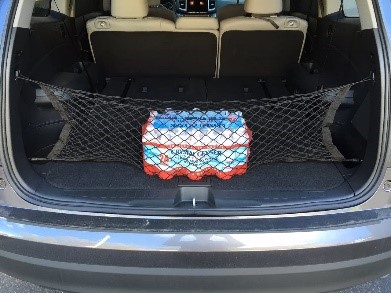
Admitting defeat, another-dumb-customer-who-can’t-figure-out-a-simple-task-like- installing-a-cargo-net, and I contact the dealership.
“You need a special tool, only dealerships have it.”
I rest my case.
Note to the astute reader: The topic above appeared before, in a different context, in the blog entry, ‘Musings from a Sunday.’ Apologies but as my Mother would say when we pointed out that we’ve already had the pleasure of one of her bromides, “Bears repeating.”
| 1. | ↑ | To the interested, ‘continuously’ would indicate duration without interruption. This pump interrupted. |
| 2. | ↑ | So, what did I do? I removed both plugs so that now the fountain is a well of wondrous water that keeps admirers at a safe distance. |