
Admit it, when you buy a jigsaw1The name ‘jigsaw’ came to be associated with the puzzle around 1880 when fretsaws became the tool of choice for cutting the shapes. Since fretsaws are distinct from jigsaws, the name appears to be a misnomer. The ‘fret’, however, does have a certain amount of verisimilitude. puzzle you wonder,
“Is this the one puzzle of the gazillion jig saw puzzles produced that’s missing a piece?”
The wondering doesn’t stop there and you surmise how it could happen. The disgruntled employee, fired for studying for his PhD on company time, on his last day on the job, opens the box, takes out a piece, reseals the contents and makes sure shipping sends it your way. And not an edge piece, no, you’d discover that right away; the piece or pieces missing are the key to getting Mona Lisa to smile.
The wondering continues as you spread the pieces on that piece of felt you paid $49.95 for (more on that later) and as you struggle you conclude, “There’s gotta be a piece missing!”
Of course, there’s no piece missing. It’s you that’s missing the patience and confidence to solve this bloody thing.
I was never a fan but peer pressure at the cottage forced me to show some interest in jig saw puzzles.
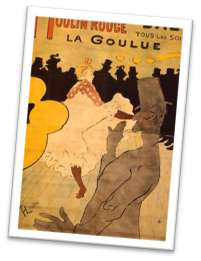
I mean, this is a trivial task. To start, you have to turn over all the pieces, I could handle that in public school. Then you have to set out all the edge pieces. That I mastered doing in high school. Then you have to look for something in the accompanying picture that you could quickly build; how ‘bout working on the letters in ‘Moulin Rouge’? That problem solving focus I acquired in third year engineering.
Why do we do it, then? Why do we put our back out from repeatedly standing and bending; why do we punish our eyes from staring at a teeny, tiny piece of cardboard; why do we spend hours at a time at this and then realize this unfinished masterwork has to be moved somehow to free up the table for dinner?
I know, when you get a piece to fit without hammering it in with your fist, you get a dopamine hit. Talk about simple pleasures.
Now that the picture is taking some shape, you tackle the monochromatic wall that commands half the picture. Had you paid the slightest attention to the puzzle when you bought it, you would have noticed that vast stretch of ochre without a hint of relief and quickly gone for the puzzle of the Magna Carta in Latin.
But you can do the wall. Now that you’ve lowered yourself to this level of cerebral challenge, you decide you’re going to show the world that you’re one smart dude and can analyze the problem scientifically, professionally, maturely to guarantee a rewarding solution.
No, you say to yourself, I will not test every single piece of amber-bay-beige by trying to jam it into the welcoming piece then picking at it to get it out then turning it 90 degrees and trying again to jam it into the welcoming piece then picking out the now frayed piece turning 90 degrees …
No, you will expertly study the scene looking for minor variations in the bland backdrop. You decide to look to a magnifying glass to help unravel the mystery. Then you bring your favourite reading lamp to the game; the one with the high octane bulb you favour when you want to read the fine print on your lottery win. All this to give this exercise the intensity a person of your learned and competitive nature demands. You will bring this beast to ground.
When you can’t take that two Tylenol pain that’s hammering the back of your head any longer, you move on. You work on the mole on the subject’s visage instead; you’ve seen that piece somewhere.
Now for that two square foot piece of felt you paid more for than a square mile of the finest cashmere. The entrepreneur that bemoaned the fact that you had to move the unfinished puzzle to eat at the dining room table figured out that he or she could make a buck by supplying a piece of felt that you just roll up for another day.
To get the most for the felt, however, he/she had to include:
- Instructions (my favourite)
- A piece of plastic that you inflate to create a roll that you will then use to wrap the piece of felt around. That piece of felt is currently holding the 7 pieces you managed to connect in your first hour plus the remaining 1,000 – 7 scattered pieces of the puzzle.
- Two elastics to hold the piece of felt you wrapped around the inflated sausage of plastic so your life’s work doesn’t unroll.
- And finally, a piece of rejected material that becomes a sack to hold the piece of felt rolled around the tubular balloon you’ve lost a lung over trying to inflate and securely fastened with two elastic bands.
| Cost of materials: | $2.07 |
| Skills required: | However long it took one to learn to write instructions that require grade one level reading skills. |
Now, solving a jig saw puzzle isn’t a singular event; everyone gets to have a hand in. Family members and visiting friends who questioned your maturity when you bought it, surprisingly take a passing interest when they can pick up a piece, seemingly at random, and plop it accurately into the place where it should go that you haven’t been able to sort out for the better part of a morning. But they can’t just walk away as they walk away,
“How long have you been working on this?” comes the disdain.
You want to remove the piece they just put in and triumphantly replace it yourself. You think ahead, “Better hide a couple of pieces in case they come along when I’m not here and finish the darn thing.”
And so it goes, but you pay for your pastime. There’s probably a post doctoral thesis that confirms the more expensive the puzzle the more time it takes to solve it. And the more, from doubtless a future study, satisfaction you get from piecing it all together.
“You know that puzzle of the Magna Carta in Latin?” you rhetorically ask of no one in particular.
“No.”
“I solved it.”
For me there’s always a final let down; you finished it, now what? You stare at the finished impression of this artist’s masterpiece and decide, even though it’s the only Henri de Toulouse-Lautrec you’ve got, not to get it framed.
You’re now at the crossroads: you’re never going to do it again; hard to make it a gift and tearing it apart would only reawaken your three year old tantrum days. So you gently dismantle it, preserving some recognizable chunks for future admiration, and put everything high up on the shelf that harbours your revered 33 and 1/3 Gene Autry LPs and move on to the more important things in life now that you’ve cleared the table, so to speak.
“What’s for dinner?”
| 1. | ↑ | The name ‘jigsaw’ came to be associated with the puzzle around 1880 when fretsaws became the tool of choice for cutting the shapes. Since fretsaws are distinct from jigsaws, the name appears to be a misnomer. The ‘fret’, however, does have a certain amount of verisimilitude. |